Cambodia
 Cambodia
⌘K
Overview
- Background
- Most Cambodians consider themselves to be Khmers, descendants of the Angkor Empire that extended over much of Southeast Asia and reached its zenith between the 10th and 13th centuries. Attacks by the Thai and Cham (from present-day Vietnam) weakened the empire, ushering in a long period of decline. The king placed the country under French protection in 1863, and it became part of French Indochina in 1887. Following Japanese occupation in World War II, Cambodia gained full independence from France in 1953. In 1975, after a seven-year struggle, communist Khmer Rouge forces captured Phnom Penh and evacuated all cities and towns. At least 1.5 million Cambodians died from execution, forced hardships, or starvation during the Khmer Rouge regime under POL POT. A 1978 Vietnamese invasion drove the Khmer Rouge into the countryside, began a 10-year Vietnamese occupation, and touched off 13 years of internecine warfare in which a coalition of Khmer Rouge, Cambodian nationalists, and royalist insurgents, with assistance from China, fought the Vietnamese-backed People’s Republic of Kampuchea (PRK).
The 1991 Paris Agreements ended the country’s civil war and mandated democratic elections, which took place in 1993 and ushered in a period of multi-party democracy with a constitutional monarchy. King Norodom SIHANOUK was reinstated as head of state, and the Cambodian People's Party (CPP) and the royalist FUNCINPEC party formed a coalition government. Nevertheless, the power-sharing arrangement proved fractious and fragile, and in 1997, a coup led by CPP leader and former PRK prime minister HUN SEN dissolved the coalition and sidelined FUNCINPEC. Despite further attempts at coalition governance, the CPP has since remained in power through elections criticized for lacking fairness, political and judicial corruption, media control, and influence over labor unions, all of which have been enforced with violence and intimidation. HUN SEN remained as prime minister until 2023, when he transferred power to his son, HUN MANET. HUN SEN has subsequently maintained considerable influence as the leader of the CPP and the Senate. The CPP has also placed limits on civil society, press freedom, and freedom of expression. Despite some economic growth and considerable investment from China over the past decade, Cambodia remains one of East Asia's poorest countries.
The remaining elements of the Khmer Rouge surrendered in 1999. A UN-backed special tribunal established in Cambodia in 1997 tried some of the surviving Khmer Rouge leaders for crimes against humanity and genocide. The tribunal concluded in 2022 with three convictions.
Geography
Area
- Land
- 176,515 sq km
- Water
- 4,520 sq km
- Total
- 181,035 sq km
- Climate
- tropical; rainy, monsoon season (May to November); dry season (December to April); little seasonal temperature variation
- Terrain
- mostly low, flat plains; mountains in southwest and north
Land Use
- Other
- 25.8% (2023 est.)
- Forest
- 39.4% (2023 est.)
- Agricultural land
- 34.9% (2023 est.)
- Agricultural land: arable land
- arable land: 23.3% (2023 est.)
- Agricultural land: permanent crops
- permanent crops: 3% (2023 est.)
- Agricultural land: permanent pasture
- permanent pasture: 8.5% (2023 est.)
- Location
- Southeastern Asia, bordering the Gulf of Thailand, between Thailand, Vietnam, and Laos
- Coastline
- 443 km
Elevation
- Lowest point
- Gulf of Thailand 0 m
- Highest point
- Phnum Aoral 1,810 m
- Mean elevation
- 126 m
- Irrigated land
- 3,540 sq km (2012)
- Map references
- Southeast Asia
Land Boundaries
- Total
- 2,530 km
- Border countries
- Laos 555 km; Thailand 817 km; Vietnam 1158 km
Maritime Claims
- Contiguous zone
- 24 nm
- Territorial sea
- 12 nm
- Continental shelf
- 200 nm
- Exclusive economic zone
- 200 nm
- Natural hazards
- monsoonal rains (June to November); flooding; occasional droughts
- Geography note
- a land of paddies and forests dominated by the Mekong River and Tonle Sap (Southeast Asia's largest freshwater lake)
- Natural resources
- oil and gas, timber, gemstones, iron ore, manganese, phosphates, hydropower potential, arable land
- Area comparative
- 1.5 times the size of Pennsylvania; slightly smaller than Oklahoma
- Geographic coordinates
- 13 00 N, 105 00 E
- Population distribution
- population concentrated in the southeast, particularly in and around the capital of Phnom Penh; further distribution is linked closely to the Tonle Sap and Mekong Rivers
Major Lakes (Area Sq Km)
- Fresh water lake(s)
- Tonle Sap - 2,700-16,000 sq km
Major Watersheds (Area Sq Km)
- Pacific ocean drainage
- Mekong (805,604 sq km)
- Major rivers (BY length in km)
- Mekong (shared with China [s], Burma, Thailand, Laos, and Vietnam [m]) - 4,350 km
note: [s] after country name indicates river source; [m] after country name indicates river mouth
People & Society
Literacy
- Male
- 81.5% (2021 est.)
- Female
- 63.6% (2021 est.)
- Total population
- 71.9% (2021 est.)
Languages
- Languages
- Khmer (official) 95.8%, minority languages 2.9%, Chinese 0.6%, Vietnamese 0.5%, other 0.2% (2019 est.)
- Major language sample(s)
សៀវភៅហេតុការណនៅលើពិភពលោក។ ទីតាំងពត៏មានមូលដានគ្រឹះយាងសំខាន់។. (Khmer)
The World Factbook, the indispensable source for basic information.
- Religions
- Buddhist (official) 97.1%, Muslim 2%, Christian 0.3%, other 0.5% (2019 est.)
Sex Ratio
- At birth
- 1.04 male(s)/female
- 0 14 years
- 1.02 male(s)/female
- 15 64 years
- 0.95 male(s)/female
- Total population
- 0.94 male(s)/female (2024 est.)
- 65 years and over
- 0.55 male(s)/female
- Birth rate
- 17.74 births/1,000 population (2025 est.)
- Death rate
- 5.62 deaths/1,000 population (2025 est.)
Median Age
- Male
- 26.9 years
- Total
- 28.3 years (2025 est.)
- Female
- 28.9 years
Population
- Male
- 8,362,224
- Total
- 17,230,333 (2025 est.)
- Female
- 8,868,109
Nationality
- Noun
- Cambodian(s)
- Adjective
- Cambodian
Tobacco Use
- Male
- 24.9% (2025 est.)
- Total
- 14.5% (2025 est.)
- Female
- 4.7% (2025 est.)
Urbanization
- Urban population
- 25.6% of total population (2023)
- Rate of urbanization
- 3.06% annual rate of change (2020-25 est.)
Age Structure
- 0 14 years
- 28.9% (male 2,497,056/female 2,436,618)
- 15 64 years
- 65.8% (male 5,456,941/female 5,765,206)
- 65 years and over
- 5.3% (2024 est.) (male 323,591/female 584,257)
- Ethnic groups
- Khmer 95.4%, Cham 2.4%, Chinese 1.5%, other 0.7% (2019-20 est.)
Child Marriage
- Men married BY age 18
- 3.3% (2022)
- Women married BY age 15
- 1.9% (2022)
- Women married BY age 18
- 17.9% (2022)
Dependency Ratios
- Total dependency ratio
- 51.2 (2025 est.)
- Youth dependency ratio
- 42.9 (2025 est.)
- Potential support ratio
- 11.9 (2025 est.)
- Elderly dependency ratio
- 8.4 (2025 est.)
- Physician density
- 0.21 physicians/1,000 population (2019)
Health Expenditure
- Health expenditure (as % of GDP)
- 7.5% of GDP (2021)
- Health expenditure (as % of national budget)
- 7% of national budget (2022 est.)
- Net migration rate
- -2.62 migrant(s)/1,000 population (2025 est.)
- Hospital bed density
- 0.7 beds/1,000 population (2018 est.)
- Total fertility rate
- 2.14 children born/woman (2025 est.)
Drinking Water Source
- Improved: rural
- rural: 72.8% of population (2022 est.)
- Improved: total
- total: 78% of population (2022 est.)
- Improved: urban
- urban: 93.6% of population (2022 est.)
- Unimproved: rural
- rural: 27.2% of population (2022 est.)
- Unimproved: total
- total: 22% of population (2022 est.)
- Unimproved: urban
- urban: 6.4% of population (2022 est.)
Education Expenditure
- Education expenditure (% GDP)
- 2.2% of GDP (2023 est.)
- Education expenditure (% national budget)
- 11.6% national budget (2025 est.)
Infant Mortality Rate
- Male
- 31.3 deaths/1,000 live births
- Total
- 27.2 deaths/1,000 live births (2025 est.)
- Female
- 24.4 deaths/1,000 live births
- Population growth rate
- 0.95% (2025 est.)
- Gross reproduction rate
- 1.05 (2025 est.)
- Population distribution
- population concentrated in the southeast, particularly in and around the capital of Phnom Penh; further distribution is linked closely to the Tonle Sap and Mekong Rivers
Life Expectancy at Birth
- Male
- 69.6 years
- Female
- 73.3 years
- Total population
- 71.4 years (2024 est.)
- Maternal mortality ratio
- 137 deaths/100,000 live births (2023 est.)
Sanitation Facility Access
- Improved: rural
- rural: 79.6% of population (2022 est.)
- Improved: total
- total: 84.7% of population (2022 est.)
- Improved: urban
- urban: 100% of population (2022 est.)
- Unimproved: rural
- rural: 20.4% of population (2022 est.)
- Unimproved: total
- total: 15.3% of population (2022 est.)
- Unimproved: urban
- urban: 0% of population (2022 est.)
Alcohol Consumption Per Capita
- Beer
- 4.12 liters of pure alcohol (2019 est.)
- Wine
- 0.03 liters of pure alcohol (2019 est.)
- Total
- 4.56 liters of pure alcohol (2019 est.)
- Spirits
- 0.41 liters of pure alcohol (2019 est.)
- Other alcohols
- 0 liters of pure alcohol (2019 est.)
- Major urban areas population
- 2.281 million PHNOM PENH (capital) (2023)
- Obesity adult prevalence rate
- 3.9% (2016)
- Mother's mean age at first birth
- 23.3 years (2021-22 est.)
- Currently married women (ages 15 49)
- 67.2% (2022 est.)
- Children under the age of 5 years underweight
- 16.3% (2021 est.)
School Life Expectancy (Primary to Tertiary Education)
- Male
- 11 years (2023 est.)
- Total
- 11 years (2023 est.)
- Female
- 11 years (2023 est.)
Government
Civica · structure
How power is organised
ExecutiveLegislative
- Flag
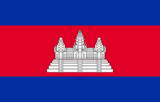
- description: three horizontal bands of blue (top), red (double-width), and blue; a three-towered, stylized white temple outlined in black is in the center of the red band, representing Angkor Wat
meaning: red and blue are traditional Cambodian colors
Capital
- Name
- Phnom Penh
- Etymology
- the name means "mountain of plenty," from the Cambodian words phnom (mountain or hill) and penh (full)
- Time difference
- UTC+7 (12 hours ahead of Washington, DC, during Standard Time)
- Geographic coordinates
- 11 33 N, 104 55 E
- Suffrage
- 18 years of age; universal
Citizenship
- Citizenship BY birth
- no
- Citizenship BY descent only
- at least one parent must be a citizen of Cambodia
- Dual citizenship recognized
- yes
- Residency requirement for naturalization
- 7 years
Constitution
- History
- previous 1947; latest promulgated 21 September 1993
- Amendment process
- proposed by the monarch, by the prime minister, or by the president of the National Assembly if supported by one fourth of the Assembly membership; passage requires two-thirds majority of the Assembly membership; constitutional articles on the multiparty democratic form of government and the monarchy cannot be amended
Country Name
- Former
- Khmer Republic, Democratic Kampuchea, People's Republic of Kampuchea, State of Cambodia
- Etymology
- the name is derived from Kambu, a legendary ancestor of the Cambodian people
- Local long form
- Preahreacheanachakr Kampuchea (phonetic transliteration)
- Local short form
- Kampuchea
- Conventional long form
- Kingdom of Cambodia
- Conventional short form
- Cambodia
- Independence
- 9 November 1953 (from France)
- Legal system
- civil law system (influenced by the UN Transitional Authority in Cambodia), customary law, Communist legal theory, and common law
- Government type
- parliamentary constitutional monarchy
Judicial Branch
- Highest court(s)
- Supreme Council (organized into 5- and 9-judge panels and includes a court chief and deputy chief); Constitutional Court (consists of 9 members)
- Subordinate courts
- Appellate Court; provincial and municipal courts; Military Court
- Judge selection and term of office
- Supreme Court and Constitutional Council judge candidates recommended by the Supreme Council of Magistracy, a 17-member body chaired by the monarch and includes other high-level judicial officers; judges of both courts appointed by the monarch; Supreme Court judges appointed for life; Constitutional Council judges appointed for 9-year terms with one third of the court renewed every 3 years
Executive Branch
- Note
- note: MANET succeeded his father, HUN SEN, who had been prime minister since 1985
- Cabinet
- Council of Ministers named by the prime minister and appointed by the monarch
- Chief of state
- King Norodom SIHAMONI (since 29 October 2004)
- Head of government
- Prime Minister HUN MANET (since 22 August 2023)
- Election/appointment process
- monarch chosen by the 9-member Royal Council of the Throne from among all eligible males of royal descent; after legislative elections, a member of the majority party or majority coalition is named prime minister by the Chairman of the National Assembly and appointed by the monarch
- National holiday
- Independence Day, 9 November (1953)
- National color(s)
- red, blue
National Heritage
- Total world heritage sites
- 5 (all cultural)
- Selected world heritage site locales
- Angkor; Temple of Preah Vihear; Sambor Prei Kuk; Koh Ker: Archaeological Site of Ancient Lingapora or Chok Gargyar; Cambodian Memorial Sites: From centres of repression to places of peace and reflection (c)
- Political parties
- Cambodian People's Party (CPP)
United National Front for an Independent, Neutral, Peaceful and Co-operative Cambodia (FUNCINPEC)
Legislative Branch
- Legislature name
- Parliament
- Legislative structure
- bicameral
National Anthem(s)
- Title
- "Nokoreach" (Royal Kingdom)
- History
- adopted 1941, restored 1993; the anthem, based on a Cambodian folk tune, was restored after the defeat of the Communist regime
- Lyrics/music
- CHUON NAT/F. PERRUCHOT and J. JEKYLL
- National symbol(s)
- Angkor Wat temple, kouprey (wild ox)
- National coat of arms
- Cambodia’s coat of arms is also the Royal Arms of Cambodia; the lions symbolize strength, courage, and the divine protection of the monarchs; the lion on the left is a gajasingha (a lion with an elephant’s trunk), and the lion on the right is a rajasingha (royal lion); both hold five-tiered umbrellas representing the king and queen, and they stand on a blue ribbon that says “Preah Chao Krung Kampuche”' (King of the Kingdom of Cambodia); between the lions is a crown with the Unalome, the Buddhist and Hindu symbol for the spiritual path to enlightenment, under it and a ray of light on top
- Administrative divisions
- 24 provinces (khett, singular and plural) and 1 municipality (krong, singular and plural)
provinces: Banteay Meanchey, Battambang, Kampong Cham, Kampong Chhnang, Kampong Speu, Kampong Thom, Kampot, Kandal, Kep, Koh Kong, Kratie, Mondolkiri, Oddar Meanchey, Pailin, Preah Sihanouk, Preah Vihear, Prey Veng, Pursat, Ratanakiri, Siem Reap, Stung Treng, Svay Rieng, Takeo, Tbong Khmum
municipalities: Phnom Penh (Phnum Penh)
Legislative Branch Lower Chamber
- Chamber name
- National Assembly (Radhsphea Ney Preah Recheanachakr Kampuchea)
- Term in office
- 5 years
- Number of seats
- 125 (all directly elected)
- Electoral system
- proportional representation
- Scope of elections
- full renewal
- Most recent election date
- 7/23/2023
- Expected date of next election
- July 2028
- Percentage of women in chamber
- 13.6%
- Parties elected and seats per party
- Cambodian People's Party (CPP) (120); United National Front for an Independent, Neutral, Peaceful and Co-operative Cambodia (FUNCINPEC) (5)
Legislative Branch Upper Chamber
- Chamber name
- Senate
- Term in office
- 6 years
- Number of seats
- 62 (60 indirectly elected; 2 appointed)
- Scope of elections
- full renewal
- Most recent election date
- 2/25/2024
- Expected date of next election
- February 2030
- Percentage of women in chamber
- 19.4%
Diplomatic Representation in the US
- Fax
- [1] (202) 726-8381
- Chancery
- 4530 16th Street NW, Washington, DC 20011
- Telephone
- [1] (202) 726-7742
- Chief of mission
- Ambassador Koy KUONG (since 11 June 2025)
- Email address and website
camemb.usa@mfaic.gov.kh
https://www.embassyofcambodiadc.org/
Diplomatic Representation from the US
- Fax
- [855] (23) 728-700
- Embassy
- #1, Street 96, Sangkat Wat Phnom, Khan Daun Penh, Phnom Penh
- Telephone
- [855] (23) 728-000
- Mailing address
- 4540 Phnom Penh Place, Washington DC 20521-4540
- Chief of mission
- Ambassador (vacant); Chargé d’Affaires Bridgette L. WALKER (since August 2024)
- Email address and website
ACSPhnomPenh@state.gov
https://kh.usembassy.gov/
- International organisations
- ADB, ARF, ASEAN, CICA, EAS, FAO, G-77, IAEA, IBRD, ICAO, ICRM, IDA, IFAD, IFC, IFRCS, ILO, IMF, IMO, Interpol, IOC, IOM, IPU, ISO (correspondent), ITU, MIGA, NAM, OIF, OPCW, PCA, UN, UNAMID, UNCTAD, UNESCO, UNIDO, UNIFIL, UNISFA, UNMISS, UNWTO, UPU, WCO, WFTU (NGOs), WHO, WIPO, WMO, WTO
- International law organization participation
- accepts compulsory ICJ jurisdiction with reservations; accepts ICCt jurisdiction
Legislature
CAMBODIA · LOWER HOUSE
National Assembly
125 seats · hover a seat for the party
Total seats
125
Majority line
64
Largest party
Cambodian People's Party
Parties
10
All political parties
Upper house
CAMBODIA · UPPER HOUSE
Senate
62 seats · hover a seat for the party
Total seats
62
Majority line
32
Largest party
Cambodian People's Party
Parties
6
All political parties
Leaders
Current
Norodom Sihamoni
- Head of State
Hun Manet
- Head of Government
Economy
Budget
- Note
- note: central government revenues (excluding grants) and expenditures converted to US dollars at average official exchange rate for year indicated
- Revenues
- $7.076 billion (2023 est.)
- Expenditures
- $8.285 billion (2023 est.)
Exports
- Civica canonical (reconciled)
- $33.1B
- Note
- note: balance of payments - exports of goods and services in current dollars
- Exports 2022
- $25.497 billion (2022 est.)
- Exports 2023
- $27.753 billion (2023 est.)
- Exports 2024
- $31.712 billion (2024 est.)
Imports
- Civica canonical (reconciled)
- $33.4B
- Note
- note: balance of payments - imports of goods and services in current dollars
- Imports 2022
- $34.759 billion (2022 est.)
- Imports 2023
- $29.421 billion (2023 est.)
- Imports 2024
- $34.329 billion (2024 est.)
- Industries
- tourism, garments, construction, rice milling, fishing, wood and wood products, rubber, cement, gem mining, textiles
- Labor force
- 9.904 million (2024 est.)
Public Debt
- Civica canonical (reconciled)
- 50.3%
- Note
- note: central government debt as a % of GDP
- Public debt 2023
- 50.3% of GDP (2023 est.)
Remittances
- Note
- note: personal transfers and compensation between resident and non-resident individuals/households/entities
- Remittances 2022
- 6.5% of GDP (2022 est.)
- Remittances 2023
- 6.6% of GDP (2023 est.)
- Remittances 2024
- 6.1% of GDP (2024 est.)
Exchange Rates
- Currency
- riels (KHR) per US dollar -
- Exchange rates 2020
- 4,092.783 (2020 est.)
- Exchange rates 2021
- 4,098.723 (2021 est.)
- Exchange rates 2022
- 4,102.038 (2022 est.)
- Exchange rates 2023
- 4,110.653 (2023 est.)
- Exchange rates 2024
- 4,072.397 (2024 est.)
Debt External
- Note
- note: present value of external debt in current US dollars
- Debt external 2023
- $8.019 billion (2023 est.)
- Economic overview
- one of the fastest growing Southeast Asian economies; rebounding tourism and clothing exports; substantial manufacturing and construction sectors; new trade agreements expanding agricultural markets; significant public debt; investing in new ports and roads
Unemployment Rate
- Civica canonical (reconciled)
- 0.3%
- Note
- note: % of labor force seeking employment
- Unemployment rate 2022
- 0.3% (2022 est.)
- Unemployment rate 2023
- 0.3% (2023 est.)
- Unemployment rate 2024
- 0.3% (2024 est.)
- Exports partners
- USA 36%, Germany 6%, China 6%, Japan 6%, Thailand 5% (2023)
- Imports partners
- China 39%, Thailand 20%, Vietnam 12%, Singapore 6%, Indonesia 3% (2023)
Real GDP Per Capita
- Civica canonical (reconciled)
- $7,967
- Note
- note: data in 2021 dollars
- Real GDP per capita 2022
- $6,500 (2022 est.)
- Real GDP per capita 2023
- $6,700 (2023 est.)
- Real GDP per capita 2024
- $7,000 (2024 est.)
Real GDP Growth Rate
- Civica canonical (reconciled)
- 6.0%
- Note
- note: annual GDP % growth based on constant local currency
- Real GDP growth rate 2022
- 5.1% (2022 est.)
- Real GDP growth rate 2023
- 5% (2023 est.)
- Real GDP growth rate 2024
- 6% (2024 est.)
- Agricultural products
- cassava, rice, maize, sugarcane, vegetables, oil palm fruit, rubber, bananas, jute, pork (2023)
- Exports commodities
- garments, semiconductors, trunks and cases, footwear, gold (2023)
- Imports commodities
- refined petroleum, fabric, gold, plastic products, synthetic fabric (2023)
Current Account Balance
- Civica canonical (reconciled)
- $228.1M
- Note
- note: balance of payments - net trade and primary/secondary income in current dollars
- Current account balance 2022
- -$7.582 billion (2022 est.)
- Current account balance 2023
- $552.346 million (2023 est.)
- Current account balance 2024
- $222.108 million (2024 est.)
- Taxes and other revenues
- 12.2% (of GDP) (2023 est.)
- GDP (official exchange rate)
- $46.353 billion (2024 est.)
GDP Composition, BY End Use
- Note
- note: figures may not total 100% due to rounding or gaps in data collection
- Household consumption
- 59.8% (2024 est.)
- Government consumption
- 5.8% (2024 est.)
- Investment in inventories
- 0.6% (2024 est.)
- Investment in fixed capital
- 31.6% (2024 est.)
- Exports of goods and services
- 71.4% (2024 est.)
- Imports of goods and services
- -72.1% (2024 est.)
Average Household Expenditures
- On food
- 40.7% of household expenditures (2023 est.)
- On alcohol and tobacco
- 1.9% of household expenditures (2023 est.)
Inflation Rate (Consumer Prices)
- Civica canonical (reconciled)
- 0.8%
- Note
- note: annual % change based on consumer prices
- Inflation rate (consumer prices) 2021
- 2.9% (2021 est.)
- Inflation rate (consumer prices) 2022
- 5.3% (2022 est.)
- Inflation rate (consumer prices) 2023
- 2.1% (2023 est.)
- Industrial production growth rate
- 9.5% (2024 est.)
Real GDP (Purchasing Power Parity)
- Civica canonical (reconciled)
- $123.676 billion (2024 est.)
- Note
- note: data in 2021 dollars
- Real GDP (purchasing power parity) 2022
- $111.095 billion (2022 est.)
- Real GDP (purchasing power parity) 2023
- $116.658 billion (2023 est.)
- Real GDP (purchasing power parity) 2024
- $123.676 billion (2024 est.)
Youth Unemployment Rate (Ages 15 24)
- Male
- 0.7% (2024 est.)
- Note
- note: % of labor force ages 15-24 seeking employment
- Total
- 0.8% (2024 est.)
- Female
- 0.9% (2024 est.)
Reserves of Foreign Exchange and Gold
- Note
- note: holdings of gold (year-end prices)/foreign exchange/special drawing rights in current dollars
- Reserves of foreign exchange and gold 2022
- $17.801 billion (2022 est.)
- Reserves of foreign exchange and gold 2023
- $19.984 billion (2023 est.)
- Reserves of foreign exchange and gold 2024
- $22.506 billion (2024 est.)
GDP Composition, BY Sector of Origin
- Note
- note: figures may not total 100% due to non-allocated consumption not captured in sector-reported data
- Industry
- 41.8% (2024 est.)
- Services
- 35.6% (2024 est.)
- Agriculture
- 16.6% (2024 est.)
Energy
Coal
- Imports
- 4.36 million metric tons (2023 est.)
- Production
- 27,000 metric tons (2023 est.)
- Consumption
- 4.39 million metric tons (2023 est.)
Petroleum
- Refined petroleum consumption
- 77,000 bbl/day (2023 est.)
Electricity
- Imports
- 5.096 billion kWh (2023 est.)
- Consumption
- 16.998 billion kWh (2023 est.)
- Installed generating capacity
- 3.673 million kW (2023 est.)
- Transmission/distribution losses
- 1.882 billion kWh (2023 est.)
Electricity Access
- Electrification rural areas
- 88%
- Electrification urban areas
- 99%
- Electrification total population
- 92.3% (2022 est.)
Energy Consumption Per Capita
- Total energy consumption per capita 2023
- 15.664 million Btu/person (2023 est.)
Electricity Generation Sources
- Solar
- 5.8% of total installed capacity (2023 est.)
- Fossil fuels
- 55.5% of total installed capacity (2023 est.)
- Hydroelectricity
- 38.6% of total installed capacity (2023 est.)
- Biomass and waste
- 0.1% of total installed capacity (2023 est.)
Communications
Internet Users
- Percent of population
- 61% (2023 est.)
- Broadcast media
- mix of state-owned, joint public-private, and privately owned broadcast media; 27 TV stations, with most operating on multiple channels, including 1 state-operated station with multiple locations and 11 stations either jointly operated or privately owned, some with several locations; multi-channel cable and satellite systems; 84 radio stations, including 1 state-owned broadcaster with multiple stations and a mix of public and private broadcasters; one international broadcaster is available, as well as one TV station that is jointly run by China and the Ministry of Interior; several TV and radio operators broadcast online only (often via Facebook) (2019)
- Internet country code
- .kh
Telephones Fixed Lines
- Total subscriptions
- 29,100 (2024 est.)
- Subscriptions per 100 inhabitants
- (2024 est.) less than 1
Telephones Mobile Cellular
- Total subscriptions
- 20.5 million (2024 est.)
- Subscriptions per 100 inhabitants
- 116 (2024 est.)
Broadband Fixed Subscriptions
- Total
- 510,000 (2022 est.) Slowly increase as focus is on mobile internet
- Subscriptions per 100 inhabitants
- 3 (2022 est.)
Transport
Ports
- Large
- 0
- Small
- 0
- Medium
- 1
- Key ports
- Kampong Saom, Phsar Ream
- Very small
- 1
- Total ports
- 2 (2024)
- Ports with oil terminals
- 1
- Airports
- 12 (2025)
Railways
- Note
- note: under restoration
- Total
- 642 km (2014)
- Narrow gauge
- 642 km (2014) 1.000-m gauge
- Heliports
- 1 (2025)
Merchant Marine
- Total
- 195 (2023)
- BY type
- container ship 2, general cargo 123, oil tanker 18, other 52
- Civil aircraft registration country code prefix
- XU
Environment
- Climate
- tropical; rainy, monsoon season (May to November); dry season (December to April); little seasonal temperature variation
Land Use
- Other
- 25.8% (2023 est.)
- Forest
- 39.4% (2023 est.)
- Agricultural land
- 34.9% (2023 est.)
- Agricultural land: arable land
- arable land: 23.3% (2023 est.)
- Agricultural land: permanent crops
- permanent crops: 3% (2023 est.)
- Agricultural land: permanent pasture
- permanent pasture: 8.5% (2023 est.)
Urbanization
- Urban population
- 25.6% of total population (2023)
- Rate of urbanization
- 3.06% annual rate of change (2020-25 est.)
Waste and Recycling
- Municipal solid waste generated annually
- 1.089 million tons (2024 est.)
- Percent of municipal solid waste recycled
- 12.4% (2022 est.)
- Environmental issues
- habitat and biodiversity loss from illegal logging and strip mining; destruction of mangrove swamps; soil erosion; limited access to potable water in rural areas; illegal fishing and overfishing; deforestation leading to sediment build-up in coastal ecosystems
Total Water Withdrawal
- Municipal
- 98 million cubic meters (2022 est.)
- Industrial
- 33 million cubic meters (2022 est.)
- Agricultural
- 2.053 billion cubic meters (2022 est.)
Carbon Dioxide Emissions
- Total emissions
- 18.779 million metric tonnes of CO2 (2023 est.)
- From coal and metallurgical coke
- 8.026 million metric tonnes of CO2 (2023 est.)
- From petroleum and other liquids
- 10.753 million metric tonnes of CO2 (2023 est.)
- Particulate matter emissions
- 18.4 micrograms per cubic meter (2019 est.)
- Total renewable water resources
- 476.1 billion cubic meters (2022 est.)
International Environmental Agreements
- Party to
- Biodiversity, Climate Change, Climate Change-Kyoto Protocol, Climate Change-Paris Agreement, Comprehensive Nuclear Test Ban, Desertification, Endangered Species, Hazardous Wastes, Marine Life Conservation, Ozone Layer Protection, Ship Pollution, Tropical Timber 2006, Wetlands, Whaling
- Signed, but not ratified
- Law of the Sea
Military & Security
- Military note
- the primary responsibilities of the Royal Cambodian Armed Forces (RCAF) are border, coastal, and internal security; key security partners include China and Vietnam; in July 2025, following months of rising tensions, the RCAF and the military forces of Thailand clashed in multiple locations along their disputed border; both sides blamed the other for provoking the five-day conflict, which included cross-border artillery shelling by both sides and air attacks by RTARF fighter aircraft and drones
the RCAF was re-established in 1993 under the first coalition government from the merger of the Cambodian Government’s military forces (Cambodian People’s Armed Forces) and the two non-communist resistance forces (Sihanoukist National Army, aka National Army for Khmer Independence, and the Khmer People's National Liberation Armed Forces); thousands of communist Khmer Rouge fighters began surrendering by 1994 under a government amnesty program and the last of the Khmer Rouge forces (National Army of Democratic Kampuchea) were demobilized or absorbed into the RCAF in 1999 (2025) - Military deployments
- 340 Central African Republic (MINUSCA); 180 Lebanon (UNIFIL) (2025)
Military Expenditures
- Civica canonical (reconciled)
- 1.5%
- Military expenditures 2020
- 2.3% of GDP (2020 est.)
- Military expenditures 2021
- 2.3% of GDP (2021 est.)
- Military expenditures 2022
- 2.1% of GDP (2022 est.)
- Military expenditures 2023
- 1.5% of GDP (2023 est.)
- Military expenditures 2024
- 1.5% of GDP (2024 est.)
- Military and security forces
- Royal Cambodian Armed Forces (RCAF): Royal Cambodian Army, Royal Khmer Navy, Royal Cambodian Air Force, Royal Gendarmerie (Military Police); National Committee for Maritime Security (2025)
- Military service age and obligation
- 18 is the legal minimum age for military service for men and women (2025)
- Military equipment inventories and acquisitions
- the RCAF is armed largely with older Chinese and Russian/Soviet origin armaments; in recent years it has received limited amounts of more modern equipment from several suppliers, particularly China (2025)
- Military and security service personnel strengths
- information varies; estimated 200,000 Armed Forces, including Gendarmerie (2025)
Transnational Issues
Trafficking in Persons
- Tier rating
- Tier 3 — Cambodia does not fully meet the minimum standards for the elimination of trafficking and is not making significant efforts to do so, therefore, Cambodia remained on Tier 3; for more details, go to: https://www.state.gov/reports/2025-trafficking-in-persons-report/cambodia/
Refugees and Internally Displaced Persons
- Idps
- 2,526 (2024 est.)
- Refugees
- 28 (2024 est.)
- Stateless persons
- 75,000 (2024 est.)
Scores & Rankings
ScoreValueGlobal rankTrendAs of
Civica Index18.0 / 100as of 2024-Q4167 / 1902024-Q4
V-Dem Liberal Democracy0.06as of 2024-Q4150 / 1702024-Q4
Freedom House StatusNot Free (17/100)as of 2024-Q4—2024-Q4
Press Freedom (RSF)Partly free (50/100)as of 2024—2024
Cite this page
Cite this page
Civica. (2026). Civica Atlas — Cambodia — vintage 2026-Q1: Cambodia factbook. Civica Atlas. Retrieved May 7, 2026, from https://civicaatlas.org/factbook/cambodia
Sources: FAO FAOSTAT, ILO ILOSTAT, IMF (WEO), UN Statistics Division, UNDP HDR, UNESCO Institute for Statistics, V-Dem, WHO Global Health Observatory, World Bank, WTO Stats, CIA World Factbook, Wikidata