Cuba
 Cuba
Cuba⌘K
Overview
- Background
- The native Amerindian population of Cuba began to decline after the arrival of Christopher COLUMBUS in 1492, as the country was developed as a Spanish colony during the next several centuries. Large numbers of African slaves were imported to work the coffee and sugar plantations, and Havana became the launching point for the annual treasure fleets bound for Spain from Mexico and Peru. Spanish rule eventually provoked an independence movement, and occasional rebellions were harshly suppressed. US intervention during the Spanish-American War in 1898 assisted the Cubans in overthrowing Spanish rule. The Treaty of Paris established Cuban independence from Spain in 1898, and after three-and-a-half years of subsequent US military rule, Cuba became an independent republic in 1902.
Cuba then experienced a string of governments mostly dominated by the military and corrupt politicians. Fidel CASTRO led a rebel army to victory in 1959; his authoritarian rule held the subsequent regime together for nearly five decades. He handed off the presidency to his younger brother Raul CASTRO in 2008. Cuba's communist revolution, with Soviet support, was exported throughout Latin America and Africa during the 1960s, 1970s, and 1980s. Miguel DIAZ-CANEL Bermudez, hand-picked by Raul CASTRO to succeed him, was approved as president by the National Assembly and took office in 2018. DIAZ-CANEL was appointed First Secretary of the Communist Party in 2021 after the retirement of Raul CASTRO and continues to serve as both president and first secretary. Cuba traditionally and consistently portrays the US embargo, in place since 1961, as the source of its socioeconomic difficulties. As a result of efforts begun in 2014 to reestablish diplomatic relations, the US and Cuba reopened embassies in their respective countries in 2015. The embargo remains in place, however, and the relationship between the US and Cuba remains tense. Illicit migration of Cuban nationals to the US via maritime and overland routes has been a longstanding challenge. In 2017, the US and Cuba signed a Joint Statement ending the so-called "wet-foot, dry-foot" policy, by which Cuban nationals who reached US soil were permitted to stay. Irregular Cuban maritime migration has dropped significantly since 2016, when migrant interdictions at sea topped 5,000, but land border crossings continue.
Geography
Area
- Land
- 109,820 sq km
- Water
- 1,040 sq km
- Total
- 110,860 sq km
- Climate
- tropical; moderated by trade winds; dry season (November to April); rainy season (May to October)
- Terrain
- mostly flat to rolling plains, with rugged hills and mountains in the southeast
Land Use
- Other
- 3.5% (2023 est.)
- Forest
- 34.9% (2023 est.)
- Agricultural land
- 61.7% (2023 est.)
- Agricultural land: arable land
- arable land: 28% (2023 est.)
- Agricultural land: permanent crops
- permanent crops: 6.3% (2023 est.)
- Agricultural land: permanent pasture
- permanent pasture: 27.4% (2023 est.)
- Location
- Caribbean, island between the Caribbean Sea and the North Atlantic Ocean, 150 km south of Key West, Florida
- Coastline
- 3,735 km
Elevation
- Lowest point
- Caribbean Sea 0 m
- Highest point
- Pico Turquino 1,974 m
- Mean elevation
- 108 m
- Irrigated land
- 8,700 sq km (2012)
- Map references
- Central America and the Caribbean
Land Boundaries
- Note
- note: Guantanamo Naval Base is leased by the US and remains part of Cuba
- Total
- 28.5 km
- Border countries
- US Naval Base at Guantanamo Bay 28.5 km
Maritime Claims
- Contiguous zone
- 24 nm
- Territorial sea
- 12 nm
- Exclusive economic zone
- 200 nm
- Natural hazards
- the east coast is subject to hurricanes from August to November (in general, the country averages about one hurricane every other year); droughts are common
- Geography note
- largest country in Caribbean and westernmost island of the Greater Antilles
- Natural resources
- cobalt, nickel, iron ore, chromium, copper, salt, timber, silica, petroleum, arable land
- Area comparative
- slightly smaller than Pennsylvania
- Geographic coordinates
- 21 30 N, 80 00 W
- Population distribution
- large population clusters found throughout the country, the more significant ones being in the larger towns and cities, particularly the capital of Havana
People & Society
Literacy
- Male
- 99% (2019 est.)
- Female
- 96.3% (2019 est.)
- Total population
- 97.7% (2019 est.)
Languages
- Languages
- Spanish (official)
- Major language sample(s)
La Libreta Informativa del Mundo, la fuente indispensable de información básica. (Spanish)
The World Factbook, the indispensable source for basic information.
- Religions
- Christian 58.9%, folk religion 17.6%, Buddhist <1%, Hindu <1%, Jewish <1%, Muslim <1%, other <1%, none 23.2% (2020 est.)
Sex Ratio
- At birth
- 1.06 male(s)/female
- 0 14 years
- 1.06 male(s)/female
- 15 64 years
- 1.01 male(s)/female
- Total population
- 0.99 male(s)/female (2024 est.)
- 65 years and over
- 0.82 male(s)/female
- Birth rate
- 7.78 births/1,000 population (2025 est.)
- Death rate
- 11.42 deaths/1,000 population (2025 est.)
Median Age
- Male
- 41 years
- Total
- 46.2 years (2025 est.)
- Female
- 44.4 years
Population
- Male
- 4,950,615
- Total
- 10,059,519 (2025 est.)
- Female
- 5,108,904
Nationality
- Noun
- Cuban(s)
- Adjective
- Cuban
Tobacco Use
- Male
- 24.7% (2025 est.)
- Total
- 16.7% (2025 est.)
- Female
- 9% (2025 est.)
Urbanization
- Urban population
- 77.5% of total population (2023)
- Rate of urbanization
- 0.19% annual rate of change (2020-25 est.)
Age Structure
- 0 14 years
- 16.3% (male 918,066/female 866,578)
- 15 64 years
- 66.5% (male 3,670,531/female 3,623,658)
- 65 years and over
- 17.2% (2024 est.) (male 852,910/female 1,034,295)
- Ethnic groups
- White 64.1%, Mulatto or mixed 26.6%, Black 9.3% (2012 est.)
- People note
- illicit emigration is a continuing problem; Cubans attempt to depart the island and enter the US using homemade rafts, alien smugglers, direct flights, or falsified visas; Cubans also use non-maritime routes to enter the US including direct flights to Miami and overland via the southwest border; the number of Cubans migrating to the US surged after the announcement of normalization of US-Cuban relations in late December 2014 but has decreased since the end of the so-called "wet-foot, dry-foot" policy on 12 January 2017
Child Marriage
- Men married BY age 18
- 5.9% (2019)
- Women married BY age 15
- 4.8% (2019)
- Women married BY age 18
- 29.4% (2019)
Dependency Ratios
- Total dependency ratio
- 50.2 (2025 est.)
- Youth dependency ratio
- 22.6 (2025 est.)
- Potential support ratio
- 3.6 (2025 est.)
- Elderly dependency ratio
- 27.6 (2025 est.)
- Physician density
- 9.54 physicians/1,000 population (2021)
Health Expenditure
- Health expenditure (as % of GDP)
- 13.8% of GDP (2021)
- Health expenditure (as % of national budget)
- 21% of national budget (2022 est.)
- Net migration rate
- -2.39 migrant(s)/1,000 population (2025 est.)
- Hospital bed density
- 4.2 beds/1,000 population (2021 est.)
- Total fertility rate
- 1.49 children born/woman (2025 est.)
Drinking Water Source
- Improved: rural
- rural: 91.8% of population (2022 est.)
- Improved: total
- total: 94.7% of population (2022 est.)
- Improved: urban
- urban: 95.5% of population (2022 est.)
- Unimproved: rural
- rural: 8.2% of population (2022 est.)
- Unimproved: total
- total: 5.3% of population (2022 est.)
- Unimproved: urban
- urban: 4.5% of population (2022 est.)
Education Expenditure
- Education expenditure (% GDP)
- 8.4% of GDP (2022 est.)
- Education expenditure (% national budget)
- 17% national budget (2022 est.)
Infant Mortality Rate
- Male
- 4.5 deaths/1,000 live births
- Total
- 5.2 deaths/1,000 live births (2025 est.)
- Female
- 3.5 deaths/1,000 live births
- Population growth rate
- -0.6% (2025 est.)
- Gross reproduction rate
- 0.72 (2025 est.)
- Population distribution
- large population clusters found throughout the country, the more significant ones being in the larger towns and cities, particularly the capital of Havana
Life Expectancy at Birth
- Male
- 77.8 years
- Female
- 82.6 years
- Total population
- 80.1 years (2024 est.)
- Maternal mortality ratio
- 35 deaths/100,000 live births (2023 est.)
Sanitation Facility Access
- Improved: rural
- rural: 95.7% of population (2022 est.)
- Improved: total
- total: 97.8% of population (2022 est.)
- Improved: urban
- urban: 98.4% of population (2022 est.)
- Unimproved: rural
- rural: 4.3% of population (2022 est.)
- Unimproved: total
- total: 2.2% of population (2022 est.)
- Unimproved: urban
- urban: 1.6% of population (2022 est.)
Alcohol Consumption Per Capita
- Beer
- 1.77 liters of pure alcohol (2019 est.)
- Wine
- 0.23 liters of pure alcohol (2019 est.)
- Total
- 4.7 liters of pure alcohol (2019 est.)
- Spirits
- 2.69 liters of pure alcohol (2019 est.)
- Other alcohols
- 0.01 liters of pure alcohol (2019 est.)
- Major urban areas population
- 2.149 million HAVANA (capital) (2023)
- Obesity adult prevalence rate
- 24.6% (2016)
- Currently married women (ages 15 49)
- 58.6% (2019 est.)
- Children under the age of 5 years underweight
- 2.4% (2019 est.)
School Life Expectancy (Primary to Tertiary Education)
- Male
- 13 years (2023 est.)
- Total
- 14 years (2023 est.)
- Female
- 15 years (2023 est.)
Government
Civica · structure
How power is organised
ExecutiveLegislative
- Flag
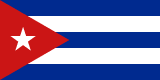
- description: five equal horizontal bands of blue (top, center, and bottom) alternating with white; a red equilateral triangle based on the left side has a five-pointed white star in the center
meaning: the blue bands stand for the islands' three former departments: Central, Occidental, and Oriental; the white bands for the purity of the independence ideal; the triangle for liberty, equality, and fraternity; the red color for the blood shed in the independence struggle; the white star, called "La Estrella Solitaria" (the Lone Star), lights the way to freedom and was inspired by the state flag of Texas
Capital
- Name
- Havana
- Etymology
- Spanish soldier Diego VELAZQUEZ named the city San Cristobal de la Habana, or Saint Christopher of the Habana; "Habana" may have been the name of a local ethnic group, but the meaning of the word is unknown
- Time difference
- UTC-5 (same time as Washington, DC, during Standard Time)
- Daylight saving time
- +1hr, begins second Sunday in March; ends first Sunday in November; note - Cuba has been known to alter the schedule of DST on short notice in an attempt to conserve electricity for lighting
- Geographic coordinates
- 23 07 N, 82 21 W
- Suffrage
- 16 years of age; universal
Citizenship
- Citizenship BY birth
- yes
- Citizenship BY descent only
- yes
- Dual citizenship recognized
- no
- Residency requirement for naturalization
- unknown
Constitution
- History
- several previous; latest drafted 14 July 2018, approved by the National Assembly 22 December 2018, approved by referendum 24 February 2019
- Amendment process
- proposed by the National Assembly of People’s Power; passage requires approval of at least two-thirds majority of the National Assembly membership; amendments to constitutional articles on the authorities of the National Assembly, Council of State, or any rights and duties in the constitution also require approval in a referendum; constitutional articles on the Cuban political, social, and economic system cannot be amended
Country Name
- Etymology
- the origin of the name is disputed; it could be derived from a local Taino word, either cubao, meaning "where fertile land is abundant," or coabana, meaning "great place"
- Local long form
- República de Cuba
- Local short form
- Cuba
- Conventional long form
- Republic of Cuba
- Conventional short form
- Cuba
- Independence
- 20 May 1902 (from US administration); 10 December 1898 (from Spain); not acknowledged by the Cuban Government as days of independence
- Legal system
- civil law system based on Spanish civil code
- Government type
- communist state
Judicial Branch
- Highest court(s)
- People's Supreme Court (consists of court president, vice president, 41 professional justices, and NA lay judges); organization includes the State Council, criminal, civil, administrative, labor, crimes against the state, and military courts)
- Subordinate courts
- People's Provincial Courts; People's Regional Courts; People's Courts
- Judge selection and term of office
- professional judges elected by the National Assembly are not subject to a specific term; lay judges nominated by workplace collectives and neighborhood associations and elected by municipal or provincial assemblies; lay judges appointed for 5-year terms and serve up to 30 days per year
Executive Branch
- Cabinet
- Council of Ministers proposed by the president and appointed by the National Assembly
- Chief of state
- President Miguel DIAZ-CANEL Bermudez (since 19 April 2018)
- Election results
2023: Miguel DIAZ-CANEL Bermudez (PCC) reelected president; percent of National Assembly vote - 97.7%; Salvador Antonio VALDES Mesa (PCC) reelected vice president; percent of National Assembly vote - 93.4%
2018: Miguel DIAZ-CANEL Bermudez (PCC) elected president; percent of National Assembly vote - 98.8%; Salvador Antonio VALDES Mesa (PCC) elected vice president; percent of National Assembly vote - 98.1%- Head of government
- Prime Minister Manuel MARRERO Cruz (since 21 December 2019)
- Most recent election date
- 19 April 2023
- Election/appointment process
- president and vice president indirectly elected by the National Assembly for a 5-year term (eligible for a second term)
- Expected date of next election
- 2028
- National holiday
- Triumph of the Revolution (Liberation Day), 1 January (1959)
- National color(s)
- red, white, blue
National Heritage
- Total world heritage sites
- 9 (7 cultural, 2 natural)
- Selected world heritage site locales
- Old Havana (c); Trinidad and the Valley de los Ingenios (c); San Pedro de la Roca Castle (c); Desembarco del Granma National Park (n); Viñales Valley (c); Archaeological Landscape of the First Coffee Plantations (c); Alejandro de Humboldt National Park (n); Historic Cienfuegos (c); Historic Camagüey (c)
- Political parties
- Cuban Communist Party or PCC
Legislative Branch
- Note
- note: the National Candidature Commission submits a slate of approved candidates; to be elected, candidates must receive more than 50% of valid votes, otherwise the seat remains vacant or the Council of State can declare another election
- Term in office
- 5 years
- Number of seats
- 470 (all directly elected)
- Electoral system
- other systems
- Legislature name
- National Assembly of the People's Power (Asamblea nacional del Poder popular)
- Scope of elections
- full renewal
- Legislative structure
- unicameral
- Most recent election date
- 3/26/2023
- Expected date of next election
- March 2028
- Percentage of women in chamber
- 55.7%
National Anthem(s)
- Title
- "La Bayamesa" (The Bayamo Song)
- History
- adopted 1940; Pedro FIGUEREDO first performed it in 1868 during the Ten Years War against the Spanish; a leading figure in the uprising, FIGUEREDO was captured in 1870 and executed by a firing squad; just before being shot, he is said to have shouted, "Morir por la Patria es vivir" (To die for the country is to live), a line from the anthem
- Lyrics/music
- Pedro FIGUEREDO
- National symbol(s)
- royal palm
- Administrative divisions
- 15 provinces (provincias, singular - provincia) and 1 special municipality* (municipio especial); Artemisa, Camaguey, Ciego de Avila, Cienfuegos, Granma, Guantanamo, Holguin, Isla de la Juventud*, La Habana (Havana), Las Tunas, Matanzas, Mayabeque, Pinar del Río, Sancti Spiritus, Santiago de Cuba, Villa Clara
Diplomatic Representation in the US
- Fax
- [1] (202) 797-8521
- Chancery
- 2630 16th Street NW, Washington, DC 20009
- Telephone
- [1] (202) 797-8515
- Chief of mission
- Ambassador (vacant); Chargé d'Affaires Lianys TORRES RIVERA (since 14 January 2021)
- Email address and website
recepcion@usadc.embacuba.cu
https://misiones.cubaminrex.cu/en/usa/embassy-cuba-usa
Diplomatic Representation from the US
- Fax
- [53] (7) 839-4247
- Embassy
- Calzada between L & M Streets, Vedado, Havana
- Telephone
- [53] (7) 839-4100
- Mailing address
- 3200 Havana Place, Washington DC 20521-3200
- Chief of mission
- Ambassador (vacant); Chargé d'Affaires Mike HAMMER (since 14 November 2024)
- Email address and website
acshavana@state.gov
https://cu.usembassy.gov/
- International organisations
- ACP, ACS, ALBA, AOSIS, CABEI, CELAC, EAEU (observer), FAO, G-77, IAEA, ICAO, ICC (national committees), ICRM, IFAD, IFRCS, IHO, ILO, IMO, IMSO, Interpol, IOC, IOM (observer), IPU, ISO, ITSO, ITU, LAES, LAIA, NAM, OAS (excluded from formal participation since 1962), OPANAL, OPCW, PCA, Petrocaribe, PIF (partner), UN, UNCTAD, UNESCO, UNHRC, UNIDO, Union Latina, UNOOSA, UNWTO, UPU, WCO, WFTU (NGOs), WHO, WIPO, WMO, WTO
- International law organization participation
- has not submitted an ICJ jurisdiction declaration; non-party state to the ICCt
Legislature
CUBA · LEGISLATURE
National Assembly of the People's Power
470 seats · hover a seat for the party
Total seats
470
Majority line
236
Largest party
Communist Party of Cuba
Parties
1
All political parties
Leaders
Current
Miguel Díaz-Canel
- Head of State
Manuel Marrero Cruz
- Head of Government
Economy
Budget
- Revenues
- $54.52 billion (2017 est.)
- Expenditures
- $64.64 billion (2017 est.)
Exports
- Civica canonical (reconciled)
- $8.8B
- Note
- note: GDP expenditure basis - exports of goods and services in current dollars
- Exports 2018
- $14.53 billion (2018 est.)
- Exports 2019
- $12.632 billion (2019 est.)
- Exports 2020
- $8.768 billion (2020 est.)
Imports
- Civica canonical (reconciled)
- $8.1B
- Note
- note: GDP expenditure basis - imports of goods and services in current dollars
- Imports 2018
- $12.567 billion (2018 est.)
- Imports 2019
- $10.971 billion (2019 est.)
- Imports 2020
- $8.067 billion (2020 est.)
- Industries
- petroleum, nickel, cobalt, pharmaceuticals, tobacco, construction, steel, cement, agricultural machinery, sugar
- Labor force
- 4.859 million (2024 est.)
Public Debt
- Civica canonical (reconciled)
- 42.7% of GDP (2016 est.)
- Public debt 2016
- 42.7% of GDP (2016 est.)
Exchange Rates
- Note
- note: official exchange rate of 24 Cuban pesos per US dollar effective 1 January 2021
- Currency
- Cuban pesos (CUP) per US dollar -
- Exchange rates 2020
- 1 (2020 est.)
- Exchange rates 2021
- 24 (2021 est.)
- Exchange rates 2022
- 24 (2022 est.)
- Exchange rates 2023
- 24 (2023 est.)
- Exchange rates 2024
- 24 (2024 est.)
- Economic overview
- still largely state-run planned economy, although privatization increasing under new constitution; widespread protests due to lack of basic necessities and electricity; massive foreign investment increases recently; known tobacco exporter; unique oil-for-doctors relationship with Venezuela; widespread corruption
Unemployment Rate
- Civica canonical (reconciled)
- 1.7%
- Note
- note: % of labor force seeking employment
- Unemployment rate 2022
- 1.9% (2022 est.)
- Unemployment rate 2023
- 1.8% (2023 est.)
- Unemployment rate 2024
- 1.6% (2024 est.)
- Exports partners
- China 34%, Spain 12%, Germany 6%, Switzerland 5%, Hong Kong 4% (2023)
- Imports partners
- Spain 24%, China 13%, Netherlands 10%, USA 9%, Canada 6% (2023)
Real GDP Per Capita
- Civica canonical (reconciled)
- $23,700 (2024 est.)
- Note
- note: data in 2015 dollars
- Real GDP per capita 2022
- $13,300 (2022 est.)
- Real GDP per capita 2023
- $18,300 (2023 est.)
- Real GDP per capita 2024
- $23,700 (2024 est.)
Real GDP Growth Rate
- Civica canonical (reconciled)
- -1.1%
- Note
- note: annual GDP % growth based on constant local currency
- Real GDP growth rate 2021
- 1.3% (2021 est.)
- Real GDP growth rate 2022
- 1.8% (2022 est.)
- Real GDP growth rate 2023
- -1.9% (2023 est.)
- Agricultural products
- sugarcane, cassava, plantains, vegetables, mangoes/guavas, milk, tomatoes, pumpkins/squash, sweet potatoes, bananas (2023)
- Exports commodities
- tobacco, nickel, liquor, zinc ore, precious metal ore (2023)
- Imports commodities
- beer, poultry, rice, plastic products, soybean oil (2023)
- GDP (official exchange rate)
- $259.781 billion (2024 est.)
GDP Composition, BY End Use
- Note
- note: figures may not total 100% due to rounding or gaps in data collection
- Household consumption
- 73.3% (2023 est.)
- Government consumption
- 25.5% (2023 est.)
- Investment in inventories
- 10% (2023 est.)
- Investment in fixed capital
- 12.3% (2023 est.)
- Exports of goods and services
- 43.5% (2023 est.)
- Imports of goods and services
- -64.6% (2023 est.)
Inflation Rate (Consumer Prices)
- Civica canonical (reconciled)
- 76.1% (2022 est.)
- Note
- note: annual % change based on consumer prices
- Inflation rate (consumer prices) 2020
- 11.9% (2020 est.)
- Inflation rate (consumer prices) 2021
- 151.9% (2021 est.)
- Inflation rate (consumer prices) 2022
- 76.1% (2022 est.)
- Industrial production growth rate
- -0.9% (2023 est.)
Real GDP (Purchasing Power Parity)
- Civica canonical (reconciled)
- $81.165 billion (2024 est.)
- Note
- note: data in 2015 dollars
- Real GDP (purchasing power parity) 2022
- $83.597 billion (2022 est.)
- Real GDP (purchasing power parity) 2023
- $81.985 billion (2023 est.)
- Real GDP (purchasing power parity) 2024
- $81.165 billion (2024 est.)
Youth Unemployment Rate (Ages 15 24)
- Male
- 4.1% (2024 est.)
- Note
- note: % of labor force ages 15-24 seeking employment
- Total
- 3.9% (2024 est.)
- Female
- 3.5% (2024 est.)
GDP Composition, BY Sector of Origin
- Note
- note: figures may not total 100% due to non-allocated consumption not captured in sector-reported data
- Industry
- 27.5% (2023 est.)
- Services
- 70% (2023 est.)
- Agriculture
- 1.3% (2023 est.)
Energy
Coal
- Exports
- 25 metric tons (2023 est.)
- Imports
- 8,000 metric tons (2023 est.)
- Consumption
- 1,000 metric tons (2023 est.)
Petroleum
- Total petroleum production
- 34,000 bbl/day (2023 est.)
- Crude oil estimated reserves
- 124 million barrels (2021 est.)
- Refined petroleum consumption
- 118,000 bbl/day (2023 est.)
Electricity
- Consumption
- 11.951 billion kWh (2023 est.)
- Installed generating capacity
- 7.264 million kW (2023 est.)
- Transmission/distribution losses
- 3.352 billion kWh (2023 est.)
Natural Gas
- Production
- 850.133 million cubic meters (2023 est.)
- Consumption
- 850.133 million cubic meters (2023 est.)
- Proven reserves
- 70.792 billion cubic meters (2021 est.)
Electricity Access
- Electrification total population
- 100% (2022 est.)
Energy Consumption Per Capita
- Total energy consumption per capita 2023
- 26.07 million Btu/person (2023 est.)
Electricity Generation Sources
- Wind
- 0.4% of total installed capacity (2023 est.)
- Solar
- 1.4% of total installed capacity (2023 est.)
- Fossil fuels
- 95.2% of total installed capacity (2023 est.)
- Hydroelectricity
- 0.8% of total installed capacity (2023 est.)
- Biomass and waste
- 2.2% of total installed capacity (2023 est.)
Communications
Internet Users
- Note
- note: private citizens are prohibited from buying computers or accessing the Internet without special authorization; foreigners may access the Internet in large hotels but are subject to firewalls; some Cubans buy illegal passwords on the black market or take advantage of public outlets to access limited email and the government-controlled "intranet"; issues relating to COVID-19 impact research into internet adoption, so actual internet user figures may be different than published numbers suggest
- Percent of population
- 71% (2023 est.)
- Broadcast media
- government owns and controls all broadcast media: 8 national TV channels (Cubavision, Cubavision Plus, Tele Rebelde, Multivision, Educational Channel 1 and 2, Canal Clave, Canal Habana), 2 international channels (Cubavision Internacional and Canal Caribe), multiple regional TV stations, 7 national radio networks, and multiple regional radio stations; the government uses the Radio-TV Marti signal; private ownership of electronic media is officially prohibited, with several online independent news sites tolerated but blocked if critical of the government; YouTube popular; Christian denominations create original video content to distribute via social media (2023)
- Internet country code
- .cu
Telephones Fixed Lines
- Total subscriptions
- 1.59 million (2024 est.)
- Subscriptions per 100 inhabitants
- 15 (2024 est.)
Telephones Mobile Cellular
- Total subscriptions
- 8.01 million (2024 est.)
- Subscriptions per 100 inhabitants
- 73 (2024 est.)
Broadband Fixed Subscriptions
- Total
- 327,000 (2023 est.)
- Subscriptions per 100 inhabitants
- 3 (2023 est.)
Transport
Ports
- Large
- 6
- Small
- 10
- Medium
- 3
- Key ports
- Antilla, Bahai de la Habana, Bahia de Sagua de Tanamo, Cabanas, Casilda, Cienfuegos, Nuevitas Bay, Puerto Guantanamo, Santiago de Cuba
- Very small
- 6
- Total ports
- 34 (2024)
- Size unknown
- 9
- Ports with oil terminals
- 14
- Airports
- 120 (2025)
Railways
- Note
- note: As of 2013, 70 km of standard gauge and 12 km of narrow gauge track were not for public use
- Total
- 8,367 km (2017)
- Narrow gauge
- 172 km (2017) 1.000-m gauge
- Standard gauge
- 8,195 km (2017) 1.435-m gauge (124 km electrified)
- Heliports
- 4 (2025)
Merchant Marine
- Total
- 65 (2023)
- BY type
- general cargo 13, oil tanker 10, other 42
- Civil aircraft registration country code prefix
- CU
Environment
- Climate
- tropical; moderated by trade winds; dry season (November to April); rainy season (May to October)
Land Use
- Other
- 3.5% (2023 est.)
- Forest
- 34.9% (2023 est.)
- Agricultural land
- 61.7% (2023 est.)
- Agricultural land: arable land
- arable land: 28% (2023 est.)
- Agricultural land: permanent crops
- permanent crops: 6.3% (2023 est.)
- Agricultural land: permanent pasture
- permanent pasture: 27.4% (2023 est.)
Urbanization
- Urban population
- 77.5% of total population (2023)
- Rate of urbanization
- 0.19% annual rate of change (2020-25 est.)
Methane Emissions
- Other
- 2.2 kt (2019-2021 est.)
- Waste
- 146.4 kt (2019-2021 est.)
- Energy
- 23 kt (2022-2024 est.)
- Agriculture
- 249.7 kt (2019-2021 est.)
Waste and Recycling
- Municipal solid waste generated annually
- 2.693 million tons (2024 est.)
- Percent of municipal solid waste recycled
- 25.7% (2022 est.)
- Environmental issues
- soil degradation and desertification (brought on by poor farming techniques and natural disasters); biodiversity loss; deforestation; air and water pollution
Total Water Withdrawal
- Municipal
- 1.7 billion cubic meters (2022 est.)
- Industrial
- 740 million cubic meters (2022 est.)
- Agricultural
- 4.519 billion cubic meters (2022 est.)
Carbon Dioxide Emissions
- Total emissions
- 19.716 million metric tonnes of CO2 (2023 est.)
- From consumed natural gas
- 1.58 million metric tonnes of CO2 (2023 est.)
- From coal and metallurgical coke
- 16,000 metric tonnes of CO2 (2023 est.)
- From petroleum and other liquids
- 18.12 million metric tonnes of CO2 (2023 est.)
- Particulate matter emissions
- 13.3 micrograms per cubic meter (2019 est.)
- Total renewable water resources
- 38.12 billion cubic meters (2022 est.)
International Environmental Agreements
- Party to
- Antarctic Treaty, Biodiversity, Climate Change, Climate Change-Kyoto Protocol, Climate Change-Paris Agreement, Comprehensive Nuclear Test Ban, Desertification, Endangered Species, Environmental Modification, Hazardous Wastes, Law of the Sea, Marine Dumping-London Convention, Ozone Layer Protection, Ship Pollution, Wetlands
- Signed, but not ratified
- Marine Life Conservation
Military & Security
- Military note
- the Cuban military is largely focused on protecting territorial integrity and the state; it perceives the US as its primary threat; the military is a central pillar of the Cuban regime and viewed as the guardian of the Cuban revolution; it has a large role in the country’s politics and economy; many senior government posts are held by military officers, and the FAR reportedly has interests in agriculture, banking and finance, construction, import/export, ports, industry, real estate, retail, shipping, transportation, and tourism (2025)
Military Expenditures
- Civica canonical (reconciled)
- 4.2% of GDP (2020 est.)
- Military expenditures 2016
- 3.1% of GDP (2016 est.)
- Military expenditures 2017
- 2.9% of GDP (2017 est.)
- Military expenditures 2018
- 2.9% of GDP (2018 est.)
- Military expenditures 2019
- 3.2% of GDP (2019 est.)
- Military expenditures 2020
- 4.2% of GDP (2020 est.)
- Military and security forces
- Revolutionary Armed Forces (Fuerzas Armadas Revolucionarias, FAR): Ground Troops (Tropas Terrestres), Revolutionary Navy (Marina de Guerra Revolucionaria, MGR), Revolutionary Air and Air Defense Forces (Defensas Anti-Aereas y Fuerza Aerea Revolucionaria, DAAFAR)
Paramilitary forces under the FAR: Youth Labor Army (Ejercito Juvenil del Trabajo, EJT), Territorial Militia Troops (Milicia de Tropas de Territoriales, MTT), Defense and Production Brigades (Brigadas de Producción y Defensa, BPD), Civil Defense Organization (Defensa Civil de Cuba)
Ministry of Interior: National Revolutionary Police (Policía Nacional Revolucionaria, PNR), Directorate of Border Guard Troops (Dirección de Tropas de Guardia Fronteriza, TGF), Department of State Security (Departamento de Seguridad del Estado, DSE) (2025) - Military service age and obligation
- military service is mandatory for all men and voluntary for women (ages 17-28); service obligation is 24 months with the Armed Forces or the Ministry of Interior; reserve commitment for men until age 45 (2025)
- Military equipment inventories and acquisitions
- the military's inventory is comprised of Russian and Soviet-era equipment (2025)
- Military and security service personnel strengths
- limited available information; estimated 50,000 active Armed Forces (2025)
Transnational Issues
Trafficking in Persons
- Tier rating
- Tier 3 — Cuba does not fully meet the minimum standards for the elimination of trafficking and is not making significant efforts to do so, therefore, Cuba remained on Tier 3; for more details, go to: https://www.state.gov/reports/2025-trafficking-in-persons-report/cuba/
Refugees and Internally Displaced Persons
- Idps
- 37,171 (2024 est.)
- Refugees
- 171 (2024 est.)
Scores & Rankings
ScoreValueGlobal rankTrendAs of
Civica Index23.0 / 100as of 2024-Q4154 / 1902024-Q4
V-Dem Liberal Democracy0.06as of 2024-Q4152 / 1702024-Q4
Freedom House StatusNot Free (8/100)as of 2024-Q4—2024-Q4
Press Freedom (RSF)Restricted press (22/100)as of 2024—2024
Cite this page
Cite this page
Civica. (2026). Civica Atlas — Cuba — vintage 2026-Q1: Cuba factbook. Civica Atlas. Retrieved May 7, 2026, from https://civicaatlas.org/factbook/cuba
Sources: FAO FAOSTAT, ILO ILOSTAT, UN Statistics Division, UNDP HDR, UNESCO Institute for Statistics, V-Dem, WHO Global Health Observatory, World Bank, WTO Stats, CIA World Factbook, Wikidata