Morocco
Some figures reconciled across multiple sources via Civica's methodology (v0.2 BETA). Methodology →
 Morocco
⌘K
Overview
- Background
- In 788, about a century after the Arab conquest of North Africa, a series of Muslim dynasties began to rule in Morocco. In the 16th century, the Sa'adi monarchy, particularly under Ahmad al-MANSUR (1578-1603), repelled foreign invaders and inaugurated a golden age. The Alaouite Dynasty, to which the current Moroccan royal family belongs, dates from the 17th century. In 1860, Spain occupied northern Morocco and ushered in a half-century of trade rivalry among European powers that saw Morocco's sovereignty steadily erode; in 1912, the French imposed a protectorate over the country. A protracted independence struggle with France ended successfully in 1956. The internationalized city of Tangier and most Spanish possessions were turned over to the new country that same year. Sultan MOHAMMED V, the current monarch's grandfather, organized the new state as a constitutional monarchy and in 1957 assumed the title of king.
Since Spain's 1976 withdrawal from Western Sahara, Morocco has extended its de facto administrative control to roughly 75% of this territory; however, the UN does not recognize Morocco as the administering power for Western Sahara. The UN since 1991 has monitored a cease-fire, which broke down in late 2020, between Morocco and the Polisario Front -- an organization advocating the territory’s independence -- and restarted negotiations over the status of the territory in 2018. In 2020, the US recognized Morocco's sovereignty over all of Western Sahara.
In 2011, King MOHAMMED VI responded to the spread of pro-democracy protests in the North Africa region by implementing a reform program that included a new constitution, passed by popular referendum, under which some new powers were extended to parliament and the prime minister, but ultimate authority remains in the hands of the monarch. Later that year, the Justice and Development Party (PJD) -- a moderate Islamist democratic party -- won the largest number of seats in parliamentary elections, becoming the first Islamist party to lead the Moroccan Government. In 2015, Morocco held its first direct elections for regional councils, which was one of the reforms included in the 2011 constitution. The PJD again won the largest number of seats in nationwide parliamentary elections in 2016, but it lost its plurality to the probusiness National Rally of Independents (RNI) in 2021. In 2020, Morocco signed a normalization agreement with Israel, similar to those that Bahrain, the United Arab Emirates, and Sudan had concluded with Israel earlier that year.
Geography
Area
- Land
- 716,300 sq km
- Water
- 250 sq km
- Total
- 716,550 sq km
- Climate
- Mediterranean in the north, becoming more extreme in the interior; in the south, hot, dry desert; rain is rare; cold offshore air currents produce fog and heavy dew
- Terrain
- mountainous northern coast (Rif Mountains) and interior (Atlas Mountains) bordered by large plateaus with intermontane valleys, and fertile coastal plains; the south is mostly low, flat desert with large areas of rocky or sandy surfaces
Land Use
- Note
- note: does not include the area of the former Western Sahara, which is almost exclusively desert
- Other
- 20.3% (2023 est.)
- Forest
- 12.8% (2023 est.)
- Agricultural land
- 66.7% (2023 est.)
- Agricultural land: arable land
- arable land: 15.4% (2023 est.)
- Agricultural land: permanent crops
- permanent crops: 4.3% (2023 est.)
- Agricultural land: permanent pasture
- permanent pasture: 47.1% (2023 est.)
- Location
- Northern Africa, bordering the North Atlantic Ocean and the Mediterranean Sea, between Algeria and Mauritania
- Coastline
- 2,945 km
Elevation
- Lowest point
- Sebkha Tah -59 m
- Highest point
- Jebel Toubkal 4,165 m
- Mean elevation
- 909 m
- Irrigated land
- 17,645 sq km (2019)
- Map references
- Africa
Land Boundaries
- Note
- note: an additional 75-meter border segment exists between Morocco and the Spanish exclave of Penon de Velez de la Gomera
- Total
- 3,523.5 km
- Border countries
- Algeria 1,941 km; Mauritania 1,564 km; Spain (Ceuta) 8 km and Spain (Melilla) 10.5 km
Maritime Claims
- Contiguous zone
- 24 nm
- Territorial sea
- 12 nm
- Continental shelf
- 200-m depth or to the depth of exploitation
- Exclusive economic zone
- 200 nm
- Natural hazards
- in the north, the mountains are geologically unstable and subject to earthquakes; periodic droughts; windstorms; flash floods; landslides; in the south, a hot, dry, dust/sand-laden sirocco wind can occur during winter and spring; widespread harmattan haze exists 60% of time, often severely restricting visibility
- Geography note
- strategic location along Strait of Gibraltar; the only African nation to have both Atlantic and Mediterranean coastlines; the waters off the Atlantic coast are particularly rich fishing areas
- Natural resources
- phosphates, iron ore, manganese, lead, zinc, fish, salt
- Area comparative
- slightly larger than twice the size of California
- Geographic coordinates
- 28 30 N, 10 00 W
- Population distribution
- the highest population density is found along the Atlantic and Mediterranean coasts; a number of densely populated agglomerations are scattered through the Atlas Mountains, as shown in this population distribution map
- Major rivers (BY length in km)
- Draa - 1,100 km
People & Society
Languages
- Note
- note: the proportion of Tamazight speakers is disputed
- Languages
- Arabic (official), Tamazight languages (Tamazight (official), Tachelhit, Tarifit), French (often the language of business, government, and diplomacy)
- Major language sample(s)
كتاب ديال لحقائق متاع العالم، احسن مصدر متاع المعلومات الأساسية (Arabic)
The World Factbook, the indispensable source for basic information.
- Religions
- Muslim 99% (official; virtually all Sunni, <0.1% Shia), other 1% (includes Christian, Jewish, and Baha'i); note - Jewish about 3,000-3,500 (2020 est.)
Sex Ratio
- At birth
- 1.05 male(s)/female
- 0 14 years
- 1.04 male(s)/female
- 15 64 years
- 0.99 male(s)/female
- Total population
- 1 male(s)/female (2024 est.)
- 65 years and over
- 0.95 male(s)/female
- Birth rate
- 16.5 births/1,000 population (2025 est.)
- Death rate
- 6.66 deaths/1,000 population (2025 est.)
Median Age
- Male
- 30.1 years
- Total
- 30.9 years (2025 est.)
- Female
- 31 years
Population
- Male
- 18,664,263
- Total
- 37,387,585 (2024 est.)
- Female
- 18,723,322
Nationality
- Noun
- Moroccan(s)
- Adjective
- Moroccan
Tobacco Use
- Male
- 23.7% (2025 est.)
- Total
- 12.3% (2025 est.)
- Female
- 0.9% (2025 est.)
Urbanization
- Note
- note: data does not include former Western Sahara
- Urban population
- 65.1% of total population (2023)
- Rate of urbanization
- 1.88% annual rate of change (2020-25 est.)
Age Structure
- 0 14 years
- 25.7% (male 4,898,154/female 4,701,786)
- 15 64 years
- 65.9% (male 12,236,752/female 12,410,567)
- 65 years and over
- 8.4% (2024 est.) (male 1,529,357/female 1,610,969)
- Ethnic groups
- Arab-Amazigh 99%, other 1%
Child Marriage
- Women married BY age 15
- 0.5% (2018)
- Women married BY age 18
- 13.7% (2018)
Dependency Ratios
- Total dependency ratio
- 51.7 (2024 est.)
- Youth dependency ratio
- 38.9 (2024 est.)
- Potential support ratio
- 7.8 (2024 est.)
- Elderly dependency ratio
- 12.7 (2024 est.)
- Physician density
- 0.74 physicians/1,000 population (2021)
Health Expenditure
- Health expenditure (as % of GDP)
- 5.7% of GDP (2021)
- Health expenditure (as % of national budget)
- 6.8% of national budget (2022 est.)
- Net migration rate
- -1.7 migrant(s)/1,000 population (2025 est.)
- Hospital bed density
- 0.7 beds/1,000 population (2020 est.)
- Total fertility rate
- 2.24 children born/woman (2025 est.)
Drinking Water Source
- Improved: rural
- rural: 65.6% of population (2022 est.)
- Improved: total
- total: 87% of population (2022 est.)
- Improved: urban
- urban: 98.8% of population (2022 est.)
- Unimproved: rural
- rural: 34.4% of population (2022 est.)
- Unimproved: total
- total: 13% of population (2022 est.)
- Unimproved: urban
- urban: 1.2% of population (2022 est.)
Education Expenditure
- Education expenditure (% GDP)
- 6% of GDP (2023 est.)
- Education expenditure (% national budget)
- 23.3% national budget (2024 est.)
Infant Mortality Rate
- Male
- 20.4 deaths/1,000 live births
- Total
- 17.8 deaths/1,000 live births (2025 est.)
- Female
- 16 deaths/1,000 live births
- Population growth rate
- 0.81% (2025 est.)
- Gross reproduction rate
- 1.09 (2025 est.)
- Population distribution
- the highest population density is found along the Atlantic and Mediterranean coasts; a number of densely populated agglomerations are scattered through the Atlas Mountains, as shown in this population distribution map
Life Expectancy at Birth
- Male
- 72.5 years
- Female
- 76 years
- Total population
- 74.2 years (2024 est.)
- Maternal mortality ratio
- 70 deaths/100,000 live births (2023 est.)
Sanitation Facility Access
- Improved: rural
- rural: 72.4% of population (2022 est.)
- Improved: total
- total: 89.1% of population (2022 est.)
- Improved: urban
- urban: 98.2% of population (2022 est.)
- Unimproved: rural
- rural: 27.6% of population (2022 est.)
- Unimproved: total
- total: 10.9% of population (2022 est.)
- Unimproved: urban
- urban: 1.8% of population (2022 est.)
Alcohol Consumption Per Capita
- Beer
- 0.18 liters of pure alcohol (2019 est.)
- Wine
- 0.24 liters of pure alcohol (2019 est.)
- Total
- 0.51 liters of pure alcohol (2019 est.)
- Spirits
- 0.09 liters of pure alcohol (2019 est.)
- Other alcohols
- 0 liters of pure alcohol (2019 est.)
- Major urban areas population
- 3.893 million Casablanca, 1.959 million RABAT (capital), 1.290 million Fes, 1.314 million Tangier, 1.050 million Marrakech, 979,000 Agadir (2023)
- Obesity adult prevalence rate
- 26.1% (2016)
- Currently married women (ages 15 49)
- 58% (2018 est.)
- Children under the age of 5 years underweight
- 3% (2019 est.)
School Life Expectancy (Primary to Tertiary Education)
- Male
- 15 years (2023 est.)
- Total
- 15 years (2023 est.)
- Female
- 15 years (2023 est.)
Government
Civica · structure
How power is organised
ExecutiveLegislative
- Flag
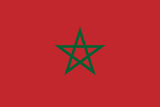
- description: red with a green pentacle (five-pointed linear star) known as Sulayman's (Solomon's) seal in the center of the flag
meaning: red and green are traditional colors in Arab flags, although the use of red is more commonly associated with the Arab states of the Persian Gulf; the pentacle represents the five pillars of Islam and the association between God and the nation
history: the design dates to 1912
Capital
- Name
- Rabat
- Etymology
- derives from the Arabic name Ribat el-Fath, from the words ribat (fortified monastery) and fath (conquest); the third Almohad sultan, Abu Yusuf Yaqub al-Manṣur, gave the name to a fort on the site in the 12th century
- Time difference
- UTC+1 (6 hours ahead of Washington, DC, during Standard Time)
- Geographic coordinates
- 34 01 N, 6 49 W
- Suffrage
- 18 years of age; universal
Citizenship
- Citizenship BY birth
- no
- Citizenship BY descent only
- the father must be a citizen of Morocco; if the father is unknown or stateless, the mother must be a citizen
- Dual citizenship recognized
- yes
- Residency requirement for naturalization
- 5 years
Constitution
- History
- several previous; latest drafted 17 June 2011, approved by referendum 1 July 2011
- Amendment process
- proposed by the king, by the prime minister, or by members in either chamber of Parliament; passage requires at least two-thirds majority vote by both chambers and approval in a referendum; the king can opt to submit self-initiated proposals directly to a referendum
Country Name
- Former
- French Protectorate in Morocco, Spanish Protectorate in Morocco, Ifni, Spanish Sahara, Western Sahara
- Etymology
- the English name of Morocco derives from, respectively, the Spanish and Portuguese names Marruecos and Marrocos, which stem from Marrakesh, the Latin name for the former capital of ancient Morocco; the Arabic name, Al Maghrib, translates as "The West"
- Local long form
- Al Mamlakah al Maghribiyah
- Local short form
- Al Maghrib
- Conventional long form
- Kingdom of Morocco
- Conventional short form
- Morocco
- Independence
- 2 March 1956 (from France)
- Legal system
- mixed system of civil law based on French civil law and Islamic (sharia) law; Constitutional Court reviews legislative acts
- Government type
- parliamentary constitutional monarchy
Judicial Branch
- Highest court(s)
- Supreme Court or Court of Cassation (consists of 5-judge panels organized into civil, family matters, commercial, administrative, social, and criminal sections); Constitutional Court (consists of 12 members)
- Subordinate courts
- courts of appeal; High Court of Justice; administrative and commercial courts; regional and Sadad courts (for religious, civil and administrative, and penal adjudication); first instance courts
- Judge selection and term of office
- Supreme Court judges appointed by the Superior Council of Judicial Power, a 20-member body presided over by the monarch, which includes the Supreme Court president, the prosecutor general, representatives of the appeals and first instance courts (among them 1 woman magistrate), the president of the National Council for Human Rights (CNDH), and 5 "notable persons" appointed by the monarch; judges appointed for life; Constitutional Court members - 6 designated by the monarch and 6 elected by Parliament; court president appointed by the monarch from among the court members; members serve 9-year nonrenewable terms
Executive Branch
- Cabinet
- Council of Ministers chosen by the prime minister in consultation with Parliament and appointed by the monarch; the monarch chooses the ministers of Interior, Foreign Affairs, Islamic Affairs, and National Defense Administration
- Chief of state
- King MOHAMMED VI (since 30 July 1999)
- Head of government
- Prime Minister Aziz AKHANNOUCH (since 7 October 2021)
- Election/appointment process
- the monarchy is hereditary; monarch appoints the prime minister from the majority party following legislative elections
- National holiday
- Throne Day (accession of King MOHAMMED VI to the throne), 30 July (1999)
- National color(s)
- red, green
National Heritage
- Total world heritage sites
- 9 (all cultural)
- Selected world heritage site locales
- Medina of Fez; Medina of Marrakesh; Ksar of Ait-Ben-Haddou; Historic City of Meknes; Archaeological Site of Volubilis; Medina of Tétouan (formerly known as Titawin); Medina of Essaouira (formerly Mogador); Portuguese City of Mazagan (El Jadida); Historic and Modern Rabat
- Political parties
- Action Party or PA
Amal (hope) Party
An-Nahj Ad-Dimocrati or An-Nahj or Democratic Way
Authenticity and Modernity Party or PAM
Constitutional Union Party or UC
Democratic and Social Movement or MDS
Democratic Forces Front or FFD
Environment and Sustainable Development Party or PEDD
Federation of the Democratic Left or FGD
Green Left Party or PGV
Istiqlal (Independence) Party or PI
Moroccan Liberal Party or PML
Moroccan Union for Democracy or UMD
National Democratic Party
National Rally of Independents or RNI
Neo-Democrats Party
Party of Development Reform or PRD
Party of Justice and Development or PJD
Party of Liberty and Social Justice or PLJS
Party of Progress and Socialism or PPS
Popular Movement or MP
Renaissance and Virtue Party or PRV
Renaissance Party
Renewal and Equity Party or PRE
Shoura (consultation) and Istiqlal Party
Socialist Union of Popular Forces or USFP
Unified Socialist Party or GSU
Unity and Democracy Party
Legislative Branch
- Legislature name
- Parliament (Barlaman)
- Legislative structure
- bicameral
National Anthem(s)
- Title
- "Hymne Cherifien" (Hymn of the Sharif)
- History
- music adopted 1956, lyrics adopted 1970
- Lyrics/music
- Ali Squalli HOUSSAINI/Leo MORGAN
- National symbol(s)
- pentacle symbol, lion
- Administrative divisions
- 12 regions; Beni Mellal-Khenifra, Casablanca-Settat, Dakhla-Oued Ed-Dahab, Draa-Tafilalet, Fes-Meknes, Guelmim-Oued Noun, Laayoune-Sakia El Hamra, Marrakech-Safi, Oriental, Rabat-Sale-Kenitra, Souss-Massa, Tanger-Tetouan-Al Hoceima
Legislative Branch Lower Chamber
- Chamber name
- House of Representatives (Majliss-annouwab)
- Term in office
- 5 years
- Number of seats
- 395 (all directly elected)
- Electoral system
- proportional representation
- Scope of elections
- full renewal
- Most recent election date
- 9/8/2021
- Expected date of next election
- September 2026
- Percentage of women in chamber
- 24.3%
- Parties elected and seats per party
- National Rally of Independents (RNI) (102); Authenticity and Modernity Party (PAM) (87); Istiqlal Party (PI) (81); Socialist Union of Popular Forces (USFP) (34); Popular Movement (MP) (28); Progress and Socialism Party (PPS) (22); Other (41)
Legislative Branch Upper Chamber
- Chamber name
- House of Councillors (Majlis al-Mustacharin)
- Term in office
- 6 years
- Number of seats
- 120 (all indirectly elected)
- Scope of elections
- full renewal
- Most recent election date
- 10/5/2021
- Expected date of next election
- October 2027
- Percentage of women in chamber
- 11.7%
Diplomatic Representation in the US
- Fax
- [1] (202) 265-0161
- Chancery
- 3508 International Drive NW, Washington, DC 20008
- Telephone
- [1] (202) 462-7979
- Chief of mission
- Ambassador Youssef AMRANI (since 27 February 2024)
- Consulate(s) general
- New York
- Email address and website
washingtonembmorocco@maec.gov.ma
Embassy of the Kingdom of Morocco in the United States (diplomatie.ma)
Diplomatic Representation from the US
- Fax
- [212] 0537-637-201
- Embassy
- Km 5.7 Avenue Mohammed VI, Souissi, Rabat 10170
- Telephone
- [212] 0537-637-200
- Mailing address
- 9400 Rabat Place, Washington DC 20521-9400
- Chief of mission
- Ambassador-designate Richard Duke BUCHAN III (since 3 December 2025)
- Consulate(s) general
- Casablanca
- Email address and website
https://ma.usembassy.gov/
- International organisations
- ABEDA, AfDB, AFESD, AIIB, AMF, AMU, AU, CAEU, CD, EBRD, FAO, G-11, G-77, IAEA, IBRD, ICAO, ICC (national committees), ICRM, IDA, IDB, IFAD, IFC, IFRCS, IHO, ILO, IMF, IMO, IMSO, Interpol, IOC, IOM, IPU, ISO, ITSO, ITU, ITUC (NGOs), LAS, MIGA, MONUSCO, NAM, OAS (observer), OIC, OIF, OPCW, OSCE (partner), Pacific Alliance (observer), Paris Club (associate), PCA, SICA (observer), UN, UNCTAD, UNESCO, UNHCR, UNIDO, UNOCI, UNOOSA, UNSC (temporary), UNWTO, UPU, WCO, WHO, WIPO, WMO, WTO
- International law organization participation
- has not submitted an ICJ jurisdiction declaration; non-party state to the ICCt
Legislature
MOROCCO · LOWER HOUSE
House of Representatives
395 seats · hover a seat for the party
Total seats
395
Majority line
199
Largest party
Justice and Development Party
Parties
14
All political parties
Upper house
MOROCCO · UPPER HOUSE
House of Councillors
120 seats · hover a seat for the party
Total seats
120
Majority line
61
Largest party
Justice and Development Party
Parties
10
All political parties
Leaders
Current
Mohammed VI of Morocco
- Head of State
Aziz Akhannouch
- Head of Government
Economy
Budget
- Note
- note: central government revenues and expenses (excluding grants/extrabudgetary units/social security funds) converted to US dollars at average official exchange rate for year indicated
- Revenues
- $38.458 billion (2023 est.)
- Expenditures
- $44.819 billion (2023 est.)
Exports
- Civica canonical (reconciled)
- $67.5B
- Note
- note: balance of payments - exports of goods and services in current dollars
- Exports 2021
- $47.09 billion (2021 est.)
- Exports 2022
- $58.575 billion (2022 est.)
- Exports 2023
- $61.746 billion (2023 est.)
Imports
- Civica canonical (reconciled)
- $80.6B
- Note
- note: balance of payments - imports of goods and services in current dollars
- Imports 2021
- $60.215 billion (2021 est.)
- Imports 2022
- $73.81 billion (2022 est.)
- Imports 2023
- $73.759 billion (2023 est.)
- Industries
- automotive parts, phosphate mining and processing, aerospace, food processing, leather goods, textiles, construction, energy, tourism
- Labor force
- 12.475 million (2024 est.)
Public Debt
- Civica canonical (reconciled)
- 64.9% of GDP (2016 est.)
- Public debt 2016
- 64.9% of GDP (2016 est.)
Remittances
- Note
- note: personal transfers and compensation between resident and non-resident individuals/households/entities
- Remittances 2021
- 7.7% of GDP (2021 est.)
- Remittances 2022
- 8.5% of GDP (2022 est.)
- Remittances 2023
- 8.1% of GDP (2023 est.)
Exchange Rates
- Currency
- Moroccan dirhams (MAD) per US dollar -
- Exchange rates 2020
- 9.497 (2020 est.)
- Exchange rates 2021
- 8.988 (2021 est.)
- Exchange rates 2022
- 10.161 (2022 est.)
- Exchange rates 2023
- 10.131 (2023 est.)
- Exchange rates 2024
- 9.942 (2024 est.)
Debt External
- Note
- note: present value of external debt in current US dollars
- Debt external 2023
- $42.262 billion (2023 est.)
- Economic overview
- lower middle-income North African economy; ongoing recovery from recent drought and earthquake; rebounding via tourism, manufacturing, and raw materials processing; significant trade and investment with EU; reform programs include fiscal rebalancing, state enterprise governance and private sector investments
Unemployment Rate
- Civica canonical (reconciled)
- 9.0%
- Note
- note: % of labor force seeking employment
- Unemployment rate 2022
- 9.5% (2022 est.)
- Unemployment rate 2023
- 9.1% (2023 est.)
- Unemployment rate 2024
- 9% (2024 est.)
- Exports partners
- Spain 20%, France 17%, Germany 6%, UK 5%, Italy 4% (2023)
- Imports partners
- Spain 16%, China 11%, France 10%, USA 9%, Turkey 5% (2023)
Real GDP Per Capita
- Civica canonical (reconciled)
- $10,415
- Note
- note: data in 2021 dollars
- Real GDP per capita 2022
- $8,700 (2022 est.)
- Real GDP per capita 2023
- $8,900 (2023 est.)
- Real GDP per capita 2024
- $9,100 (2024 est.)
Real GDP Growth Rate
- Civica canonical (reconciled)
- 3.8%
- Note
- note: annual GDP % growth based on constant local currency
- Real GDP growth rate 2022
- 1.5% (2022 est.)
- Real GDP growth rate 2023
- 3.4% (2023 est.)
- Real GDP growth rate 2024
- 3.2% (2024 est.)
- Agricultural products
- wheat, milk, potatoes, sugar beets, tomatoes, barley, olives, apples, tangerines/mandarins, onions (2023)
- Exports commodities
- fertilizers, cars, garments, insulated wire, tomatoes (2023)
- Imports commodities
- refined petroleum, cars, vehicle parts/accessories, natural gas, coal (2023)
Current Account Balance
- Civica canonical (reconciled)
- -$1.9B
- Note
- note: balance of payments - net trade and primary/secondary income in current dollars
- Current account balance 2021
- -$3.349 billion (2021 est.)
- Current account balance 2022
- -$4.8 billion (2022 est.)
- Current account balance 2023
- -$891.222 million (2023 est.)
- Taxes and other revenues
- 21% (of GDP) (2023 est.)
- GDP (official exchange rate)
- $154.431 billion (2024 est.)
GDP Composition, BY End Use
- Note
- note: figures may not total 100% due to rounding or gaps in data collection
- Household consumption
- 61.3% (2024 est.)
- Government consumption
- 18% (2024 est.)
- Investment in inventories
- 3.8% (2024 est.)
- Investment in fixed capital
- 26.1% (2024 est.)
- Exports of goods and services
- 43.3% (2024 est.)
- Imports of goods and services
- -52.5% (2024 est.)
- Population below poverty line
- 3.9% (2022 est.)
Average Household Expenditures
- On food
- 34.5% of household expenditures (2023 est.)
- On alcohol and tobacco
- 2.1% of household expenditures (2023 est.)
Inflation Rate (Consumer Prices)
- Civica canonical (reconciled)
- 1.0%
- Note
- note: annual % change based on consumer prices
- Inflation rate (consumer prices) 2022
- 6.7% (2022 est.)
- Inflation rate (consumer prices) 2023
- 6.1% (2023 est.)
- Inflation rate (consumer prices) 2024
- 1% (2024 est.)
- Industrial production growth rate
- 5% (2024 est.)
Real GDP (Purchasing Power Parity)
- Civica canonical (reconciled)
- $350.594 billion (2024 est.)
- Note
- note: data in 2021 dollars
- Real GDP (purchasing power parity) 2022
- $328.425 billion (2022 est.)
- Real GDP (purchasing power parity) 2023
- $339.603 billion (2023 est.)
- Real GDP (purchasing power parity) 2024
- $350.594 billion (2024 est.)
Youth Unemployment Rate (Ages 15 24)
- Male
- 22% (2024 est.)
- Note
- note: % of labor force ages 15-24 seeking employment
- Total
- 22.1% (2024 est.)
- Female
- 22.4% (2024 est.)
Reserves of Foreign Exchange and Gold
- Note
- note: holdings of gold (year-end prices)/foreign exchange/special drawing rights in current dollars
- Reserves of foreign exchange and gold 2022
- $32.314 billion (2022 est.)
- Reserves of foreign exchange and gold 2023
- $36.328 billion (2023 est.)
- Reserves of foreign exchange and gold 2024
- $37.134 billion (2024 est.)
GDP Composition, BY Sector of Origin
- Note
- note: figures may not total 100% due to non-allocated consumption not captured in sector-reported data
- Industry
- 24.1% (2024 est.)
- Services
- 54.1% (2024 est.)
- Agriculture
- 10.1% (2024 est.)
Energy
Coal
- Exports
- 25 metric tons (2023 est.)
- Imports
- 10.344 million metric tons (2023 est.)
- Consumption
- 10.304 million metric tons (2023 est.)
- Proven reserves
- 96 million metric tons (2023 est.)
Petroleum
- Total petroleum production
- 25 bbl/day (2023 est.)
- Crude oil estimated reserves
- 684,000 barrels (2021 est.)
- Refined petroleum consumption
- 296,000 bbl/day (2023 est.)
Electricity
- Exports
- 462 million kWh (2023 est.)
- Imports
- 2.311 billion kWh (2023 est.)
- Consumption
- 36.379 billion kWh (2023 est.)
- Installed generating capacity
- 14.615 million kW (2023 est.)
- Transmission/distribution losses
- 7.781 billion kWh (2023 est.)
Natural Gas
- Imports
- 861.38 million cubic meters (2023 est.)
- Production
- 55.473 million cubic meters (2023 est.)
- Consumption
- 912.277 million cubic meters (2023 est.)
- Proven reserves
- 1.444 billion cubic meters (2021 est.)
Electricity Access
- Electrification total population
- 100% (2022 est.)
Energy Consumption Per Capita
- Total energy consumption per capita 2023
- 23.52 million Btu/person (2023 est.)
Electricity Generation Sources
- Wind
- 15.5% of total installed capacity (2023 est.)
- Solar
- 5% of total installed capacity (2023 est.)
- Fossil fuels
- 78.6% of total installed capacity (2023 est.)
- Hydroelectricity
- 0.9% of total installed capacity (2023 est.)
- Biomass and waste
- 0.1% of total installed capacity (2023 est.)
Communications
Internet Users
- Percent of population
- 91% (2023 est.)
- Broadcast media
- 2 TV broadcast networks with state-run Radio-Television Marocaine (RTM) operating one network and the state partially owning the other; foreign TV is available via satellite dish; 3 radio broadcast networks, with RTM operating one; the state-owned network includes 10 regional radio channels in addition to its national service (2019)
- Internet country code
- .ma
Telephones Fixed Lines
- Total subscriptions
- 2.874 million (2023 est.)
- Subscriptions per 100 inhabitants
- 8 (2023 est.)
Telephones Mobile Cellular
- Total subscriptions
- 55.9 million (2023 est.)
- Subscriptions per 100 inhabitants
- 137 (2021 est.)
Broadband Fixed Subscriptions
- Total
- 2.42 million (2022 est.)
- Subscriptions per 100 inhabitants
- 6 (2022 est.)
Transport
Ports
- Large
- 3
- Small
- 3
- Medium
- 1
- Key ports
- Agadir, Casablanca, Tanger, Tangier-Mediterranean
- Very small
- 5
- Total ports
- 12 (2024)
- Ports with oil terminals
- 2
- Airports
- 48 (2025)
Railways
- Total
- 2,067 km (2014)
- Standard gauge
- 2,067 km (2014) 1.435-m gauge (1,022 km electrified)
- Heliports
- 17 (2025)
Merchant Marine
- Total
- 94 (2023)
- BY type
- container ship 6, general cargo 5, oil tanker 2, other 81
- Civil aircraft registration country code prefix
- CN
Environment
- Climate
- Mediterranean in the north, becoming more extreme in the interior; in the south, hot, dry desert; rain is rare; cold offshore air currents produce fog and heavy dew
Geoparks
- Global geoparks and regional networks
- M'Goun (2023)
- Total global geoparks and regional networks
- 1
Land Use
- Note
- note: does not include the area of the former Western Sahara, which is almost exclusively desert
- Other
- 20.3% (2023 est.)
- Forest
- 12.8% (2023 est.)
- Agricultural land
- 66.7% (2023 est.)
- Agricultural land: arable land
- arable land: 15.4% (2023 est.)
- Agricultural land: permanent crops
- permanent crops: 4.3% (2023 est.)
- Agricultural land: permanent pasture
- permanent pasture: 47.1% (2023 est.)
Urbanization
- Note
- note: data does not include former Western Sahara
- Urban population
- 65.1% of total population (2023)
- Rate of urbanization
- 1.88% annual rate of change (2020-25 est.)
Methane Emissions
- Other
- 4.5 kt (2019-2021 est.)
- Waste
- 377.5 kt (2019-2021 est.)
- Energy
- 36.6 kt (2022-2024 est.)
- Agriculture
- 283.7 kt (2019-2021 est.)
Waste and Recycling
- Note
- note: data does not include former Western Sahara
- Municipal solid waste generated annually
- 6.852 million tons (2024 est.)
- Percent of municipal solid waste recycled
- 25.4% (2022 est.)
- Environmental issues
- in the north: land degradation and desertification, with soil erosion from farming, overgrazing, and vegetation removal; water and soil pollution from industrial-waste dumping; in the south: desertification; overgrazing; sparse water
Total Water Withdrawal
- Note
- note: data does not include former Western Sahara
- Municipal
- 1.063 billion cubic meters (2022 est.)
- Industrial
- 212 million cubic meters (2022 est.)
- Agricultural
- 9.156 billion cubic meters (2022 est.)
Carbon Dioxide Emissions
- Total emissions
- 64.173 million metric tonnes of CO2 (2023 est.)
- From consumed natural gas
- 1.82 million metric tonnes of CO2 (2023 est.)
- From coal and metallurgical coke
- 23.024 million metric tonnes of CO2 (2023 est.)
- From petroleum and other liquids
- 39.329 million metric tonnes of CO2 (2023 est.)
- Particulate matter emissions
- 13.2 micrograms per cubic meter (2019 est.)
- Total renewable water resources
- 29 billion cubic meters (2022 est.)
International Environmental Agreements
- Party to
- Biodiversity, Climate Change, Climate Change-Kyoto Protocol, Climate Change-Paris Agreement, Comprehensive Nuclear Test Ban, Desertification, Endangered Species, Hazardous Wastes, Law of the Sea, Marine Dumping-London Convention, Marine Dumping-London Protocol, Nuclear Test Ban, Ozone Layer Protection, Ship Pollution, Wetlands, Whaling
- Signed, but not ratified
- Environmental Modification
Military & Security
- Military note
- the Royal Armed Forces (FAR) are responsible for protecting Morocco’s national interests, sovereignty, and territorial integrity; key areas of concern for the FAR include international terrorism, maritime security, and regional challenges such as the Polisario Front in Western Sahara and Algeria; the Polisario Front (Popular Front for the Liberation of Saguia el Hamra and Rio de Oro), an organization that seeks the independence of Western Sahara, disputes Morocco’s claim of sovereignty over the territory; Moroccan and Polisario forces fought intermittently from 1975, when Spain relinquished colonial authority over the territory, until a 1991 cease-fire and the establishment of a UN peacekeeping mission; the Polisario withdrew from the cease-fire in November 2020, and since then there have been reports of low-intensity hostilities between Morocco and the Polisario Front across the 2,500-kilometer-long berm built in 1987 that separates the two sides; Algeria is seen as a regional rival and has openly backed the Polisario Front
the FAR participates in international peacekeeping operations, as well as both bilateral and multinational training exercises; it has relations with a variety of partners including the militaries of France, Qatar, Saudi Arabia, Spain, and the US, as well as NATO, the Arab League, and the African Union; Morocco has Major Non-NATO Ally (MNNA) status with the US, a designation under US law that provides foreign partners with certain benefits in the areas of defense trade and security cooperation
the FAR was created in May 1956; Moroccans were recruited for service in the Spahi and Tirailleur regiments of the French Army during the period of the French protectorate (1912-1956), and Moroccans fought under the French Army during both World Wars, as well as the First Indochina War (1946-1954); the Spanish Army recruited Moroccans from the Spanish Protectorate during both the Rif War (1921-26) and the Spanish Civil War (1936-39)
the UN Mission for the Referendum in Western Sahara (MINURSO) was established by Security Council resolution 690 in April 1991 in accordance with settlement proposals accepted in August 1988 by Morocco and the Polisario Front; MINURSO was unable to carry out all the original settlement proposals, but continues to monitor the cease-fire and reduce the threat of mines and unexploded ordnance, and has provided logistic support to the Office of the UN High Commissioner for Refugees (UNHCR) (2025) - Military deployments
- 775 Central African Republic (MINUSCA); 890 Democratic Republic of the Congo (MONUSCO) (2025)
Military Expenditures
- Civica canonical (reconciled)
- 3.5%
- Military expenditures 2020
- 4.5% of GDP (2020 est.)
- Military expenditures 2021
- 4.5% of GDP (2021 est.)
- Military expenditures 2022
- 4.5% of GDP (2022 est.)
- Military expenditures 2023
- 4% of GDP (2023 est.)
- Military expenditures 2024
- 4% of GDP (2024 est.)
- Military and security forces
- Royal Moroccan Armed Forces (FAR): Royal Moroccan Army (includes the Moroccan Royal Guard), Royal Moroccan Navy (includes Coast Guard, marines), Royal Moroccan Air Force, Moroccan Royal Guard, Royal Moroccan Gendarmerie
Ministry of Interior: General Directorate for National Security (DGSN; aka National Police), Auxiliary Forces (2025) - Military service age and obligation
- 19-25 years of age for 12-month compulsory and voluntary military service for men and women (2025)
- Military equipment inventories and acquisitions
- the Moroccan military's inventory is mostly a mix of older and some more modern armaments from France and the US (2025)
- Military and security service personnel strengths
- estimated 220,000 active Armed Forces (175,000 Army; 10,000 Navy; 15,000 Air Force, 20,000 Gendarmerie) (2025)
Terrorism
- Terrorist group(s)
- Islamic State of Iraq and ash-Sham (ISIS)
Transnational Issues
Refugees and Internally Displaced Persons
- Idps
- 256 (2024 est.)
- Refugees
- 18,848 (2024 est.)
Scores & Rankings
ScoreValueGlobal rankTrendAs of
Civica Index34.0 / 100as of 2024-Q4126 / 1902024-Q4
Civica Pulse−1.0as of 2026-05-06—2026-05-06
V-Dem Liberal Democracy0.25as of 2024-Q4105 / 1702024-Q4
Freedom House StatusNot Free (33/100)as of 2024-Q4—2024-Q4
Press Freedom (RSF)Partly free (50/100)as of 2024—2024
Cite this page
Cite this page
Civica. (2026). Civica Atlas — Morocco — vintage 2026-Q1: Morocco factbook. Civica Atlas. Retrieved May 7, 2026, from https://civicaatlas.org/factbook/morocco
Sources: FAO FAOSTAT, ILO ILOSTAT, IMF (WEO), UN Statistics Division, UNDP HDR, UNESCO Institute for Statistics, V-Dem, WHO Global Health Observatory, World Bank, WTO Stats, CIA World Factbook, Wikidata