Namibia
 Namibia
⌘K
Overview
- Background
- Various ethnic groups occupied southwestern Africa prior to Germany establishing a colony over most of the territory in 1884. South Africa occupied the colony, then known as German South West Africa, in 1915 during World War I and administered it as a mandate until after World War II, when it annexed the territory. In 1966, the Marxist South-West Africa People's Organization (SWAPO) guerrilla group launched a war of independence for the area that became Namibia, but it was not until 1988 that South Africa agreed to end its administration in accordance with a UN peace plan for the entire region. Namibia gained independence in 1990, and SWAPO has governed it since, although the party has dropped much of its Marxist ideology. President Hage GEINGOB was elected in 2014 in a landslide victory, replacing Hifikepunye POHAMBA, who stepped down after serving two terms. SWAPO retained its parliamentary super majority in the 2014 elections. In 2019 elections, GEINGOB was reelected but by a substantially reduced majority, and SWAPO narrowly lost its super majority in parliament.
Geography
Area
- Land
- 823,290 sq km
- Water
- 1,002 sq km
- Total
- 824,292 sq km
- Climate
- desert; hot, dry; rainfall sparse and erratic
- Terrain
- mostly high plateau; Namib Desert along coast; Kalahari Desert in east
Land Use
- Other
- 43.1% (2023 est.)
- Forest
- 9.8% (2023 est.)
- Agricultural land
- 47.1% (2023 est.)
- Agricultural land: arable land
- arable land: 1% (2023 est.)
- Agricultural land: permanent crops
- permanent crops: 0% (2023 est.)
- Agricultural land: permanent pasture
- permanent pasture: 46.2% (2023 est.)
- Location
- Southern Africa, bordering the South Atlantic Ocean, between Angola and South Africa
- Coastline
- 1,572 km
Elevation
- Lowest point
- Atlantic Ocean 0 m
- Highest point
- Konigstein on Brandberg 2,573 m
- Mean elevation
- 1,141 m
- Irrigated land
- 80 sq km (2012)
- Major aquifers
- Lower Kalahari-Stampriet Basin, Upper Kalahari-Cuvelai-Upper Zambezi Basin
- Map references
- Africa
Land Boundaries
- Total
- 4,220 km
- Border countries
- Angola 1,427 km; Botswana 1,544 km; South Africa 1,005 km; Zambia 244 km
Maritime Claims
- Contiguous zone
- 24 nm
- Territorial sea
- 12 nm
- Exclusive economic zone
- 200 nm
- Natural hazards
- prolonged periods of drought
- Geography note
- the Namib Desert, after which the country is named, is considered to be the oldest desert in the world; some 14% of the land is protected, including virtually the entire Namib Desert coastal strip
- Natural resources
- diamonds, copper, uranium, gold, silver, lead, tin, lithium, cadmium, tungsten, zinc, salt, hydropower, fish
- Area comparative
- almost seven times the size of Pennsylvania; slightly more than half the size of Alaska
- Geographic coordinates
- 22 00 S, 17 00 E
- Population distribution
- population density is very low, with the largest clusters found in the extreme north-central area along the border with Angola, as shown in this population distribution map
Major Watersheds (Area Sq Km)
- Indian ocean drainage
- Zambezi (1,332,412 sq km)
- Atlantic ocean drainage
- Orange (941,351 sq km)
- Internal (endorheic basin) drainage
- Okavango Basin (863,866 sq km)
- Major rivers (BY length in km)
- Zambezi (shared with Zambia [s]), Angola, Botswana, Zimbabwe, and Mozambique [m]) - 2,740 km; Orange river mouth (shared with Lesotho [s], and South Africa) - 2,092 km; Okavango (shared with Angola [s], and Botswana [m]) - 1,600 km
note: [s] after country name indicates river source; [m] after country name indicates river mouth
People & Society
Literacy
- Male
- 87.9% (2023 est.)
- Female
- 87.4% (2023 est.)
- Total population
- 87.6% (2023 est.)
- Languages
- Oshiwambo languages 49.7%, Nama/Damara 11%, Kavango languages 10.4%, Afrikaans 9.4%, Herero languages 9.2%, Zambezi languages 4.9%, English (official) 2.3%, other African languages 1.5%, other European languages 0.7%, other 1% (2016 est.)
- Religions
- Christian 97.5%, other 0.6% (includes Muslim, Baha'i, Jewish, Buddhist), unaffiliated 1.9% (2020 est.)
Sex Ratio
- At birth
- 1.03 male(s)/female
- 0 14 years
- 1.02 male(s)/female
- 15 64 years
- 0.95 male(s)/female
- Total population
- 0.97 male(s)/female (2024 est.)
- 65 years and over
- 0.76 male(s)/female
- Birth rate
- 23.93 births/1,000 population (2025 est.)
- Death rate
- 6.36 deaths/1,000 population (2025 est.)
Median Age
- Male
- 22.1 years
- Total
- 23.1 years (2025 est.)
- Female
- 23.5 years
Population
- Male
- 1,402,136
- Total
- 2,852,777 (2025 est.)
- Female
- 1,450,641
Nationality
- Noun
- Namibian(s)
- Adjective
- Namibian
Tobacco Use
- Male
- 20.5% (2025 est.)
- Total
- 11.8% (2025 est.)
- Female
- 3.9% (2025 est.)
Urbanization
- Urban population
- 54.9% of total population (2023)
- Rate of urbanization
- 3.64% annual rate of change (2020-25 est.)
Age Structure
- 0 14 years
- 34.1% (male 482,790/female 473,306)
- 15 64 years
- 62% (male 846,810/female 890,099)
- 65 years and over
- 3.9% (2024 est.) (male 47,686/female 62,969)
- Ethnic groups
- Ovambo 50%, Kavangos 9%, Herero 7%, Damara 7%, mixed European and African ancestry 6.5%, European 6%, Nama 5%, Caprivian 4%, San 3%, Baster 2%, Tswana 0.5%
Dependency Ratios
- Total dependency ratio
- 60.5 (2025 est.)
- Youth dependency ratio
- 54 (2025 est.)
- Potential support ratio
- 15.5 (2025 est.)
- Elderly dependency ratio
- 6.5 (2025 est.)
- Physician density
- 0.55 physicians/1,000 population (2022)
Health Expenditure
- Health expenditure (as % of GDP)
- 9.4% of GDP (2021)
- Health expenditure (as % of national budget)
- 11.7% of national budget (2022 est.)
- Net migration rate
- 0 migrant(s)/1,000 population (2025 est.)
- Total fertility rate
- 2.85 children born/woman (2025 est.)
Drinking Water Source
- Improved: rural
- rural: 73.8% of population (2022 est.)
- Improved: total
- total: 85.9% of population (2022 est.)
- Improved: urban
- urban: 96.2% of population (2022 est.)
- Unimproved: rural
- rural: 26.2% of population (2022 est.)
- Unimproved: total
- total: 14.1% of population (2022 est.)
- Unimproved: urban
- urban: 3.8% of population (2022 est.)
Education Expenditure
- Education expenditure (% GDP)
- 9.1% of GDP (2024 est.)
- Education expenditure (% national budget)
- 24.6% national budget (2025 est.)
Infant Mortality Rate
- Male
- 31 deaths/1,000 live births
- Total
- 27.1 deaths/1,000 live births (2025 est.)
- Female
- 24.7 deaths/1,000 live births
- Population growth rate
- 1.76% (2025 est.)
- Gross reproduction rate
- 1.4 (2025 est.)
- Population distribution
- population density is very low, with the largest clusters found in the extreme north-central area along the border with Angola, as shown in this population distribution map
Life Expectancy at Birth
- Male
- 64.2 years
- Female
- 67.6 years
- Total population
- 65.9 years (2024 est.)
- Maternal mortality ratio
- 139 deaths/100,000 live births (2023 est.)
Sanitation Facility Access
- Improved: rural
- rural: 23.6% of population (2022 est.)
- Improved: total
- total: 49% of population (2022 est.)
- Improved: urban
- urban: 70.6% of population (2022 est.)
- Unimproved: rural
- rural: 76.4% of population (2022 est.)
- Unimproved: total
- total: 51% of population (2022 est.)
- Unimproved: urban
- urban: 29.4% of population (2022 est.)
Alcohol Consumption Per Capita
- Beer
- 1.37 liters of pure alcohol (2019 est.)
- Wine
- 0.16 liters of pure alcohol (2019 est.)
- Total
- 2.38 liters of pure alcohol (2019 est.)
- Spirits
- 0.53 liters of pure alcohol (2019 est.)
- Other alcohols
- 0.32 liters of pure alcohol (2019 est.)
- Major urban areas population
- 477,000 WINDHOEK (capital) (2023)
- Obesity adult prevalence rate
- 17.2% (2016)
- Mother's mean age at first birth
- 21.6 years (2013 est.)
- Currently married women (ages 15 49)
- 33.7% (2018 est.)
Government
Civica · structure
How power is organised
ExecutiveLegislative
- Flag
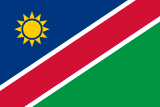
- description: a wide red stripe edged with narrow white stripes divides the flag diagonally from lower-left corner to upper-right corner; the upper triangle is blue and has a golden-yellow, 12-ray sunburst, and the lower triangle is green
meaning: red stands for the heroism of the people and their determination to build a future of equal opportunity; white stands for peace, unity, tranquility, and harmony; blue stands for the sky and the Atlantic Ocean, the sun for power and existence, and green for vegetation and agricultural resources
Capital
- Name
- Windhoek
- Etymology
- the name is an Afrikaans word meaning "windy corner;" a local Khoikhoin chief first used the name in the 19th century and may have derived it from the name of his childhood South African village of Winterhoek
- Time difference
- UTC+2 (7 hours ahead of Washington, DC, during Standard Time)
- Geographic coordinates
- 22 34 S, 17 05 E
- Suffrage
- 18 years of age; universal
Citizenship
- Citizenship BY birth
- no
- Citizenship BY descent only
- at least one parent must be a citizen of Namibia
- Dual citizenship recognized
- no
- Residency requirement for naturalization
- 5 years
Constitution
- History
- adopted 9 February 1990, entered into force 21 March 1990
- Amendment process
- passage requires majority vote of the National Assembly membership and of the National Council of Parliament and assent of the president of the republic; if the National Council fails to pass an amendment, the president can call for a referendum; passage by referendum requires two-thirds majority of votes cast; amendments that detract from or repeal constitutional articles on fundamental rights and freedoms cannot be amended, and the requisite majorities needed by Parliament to amend the constitution cannot be changed
Country Name
- Former
- German South-West Africa (Deutsch-Suedwestafrika), South-West Africa
- Etymology
- named for the coastal Namib Desert; the word namib comes from the local Nama language and means "an area where there is nothing"
- Local long form
- Republic of Namibia
- Local short form
- Namibia
- Conventional long form
- Republic of Namibia
- Conventional short form
- Namibia
- Independence
- 21 March 1990 (from South African mandate)
- Legal system
- mixed system of uncodified civil law based on Roman-Dutch law and customary law
- Government type
- presidential republic
Judicial Branch
- Highest court(s)
- Supreme Court (consists of the chief justice and at least 3 judges in quorum sessions)
- Subordinate courts
- High Court; Electoral Court, Labor Court; regional and district magistrates' courts; community courts
- Judge selection and term of office
- judges appointed by the president of Namibia on the recommendation of the Judicial Service Commission; judges serve until age 65, but terms can be extended by the president until age 70
Executive Branch
- Note
- note: the president is both chief of state and head of government
- Cabinet
- Cabinet appointed by the president from among members of the National Assembly
- Chief of state
- President Netumbo NANDI-NDAITWAH (since 21 March 2025)
- Election results
2024: Netumbo NANDI-NDAITWAH elected president in the first round; percent of vote -Netumbo NANDI-NDAITWAH (SWAPO) 57%, Panduleni ITULA (IPC) 26%, McHenry VENAANI (PDM) 5.10%, Bernadus SWARTBOOI (LPM) 4.72%, Job AMUPANDA (AR) 1.80%, Hendrik GAOBEAB (UDF) 1.16%; other 3.31%
2019: Hage GEINGOB reelected president in the first round; percent of vote - Hage GEINGOB (SWAPO) 56.3%, Panduleni ITULA (independent) 29.4%, McHenry VENAANI (PDM) 5.3%, other .9%- Head of government
- President Netumbo NANDI-NDAITWAH (since 21 March 2025)
- Most recent election date
- 27 November 2024
- Election/appointment process
- president directly elected by absolute-majority popular vote in 2 rounds, if needed, for a 5-year term (eligible for a second term)
- Expected date of next election
- November 2029
- National holiday
- Independence Day, 21 March (1990)
- National color(s)
- blue, red, green, white, yellow
National Heritage
- Total world heritage sites
- 2 (1 cultural, 1 natural)
- Selected world heritage site locales
- Twyfelfontein or /Ui-//aes (c); Namib Sand Sea (n)
- Political parties
- All People's Party or APP
Christian Democratic Voice or CDV
Landless People's Movement or LPM
National Unity Democratic Organization or NUDO
Namibian Economic Freedom Fighters or NEFF
Popular Democratic Movement or PDM (formerly Democratic Turnhalle Alliance or DTA)
Rally for Democracy and Progress or RDP
Republican Party or RP
South West Africa National Union or SWANU
South West Africa People's Organization or SWAPO
United Democratic Front or UDF
United People's Movement or UPM
Legislative Branch
- Legislature name
- Parliament
- Legislative structure
- bicameral
National Anthem(s)
- Title
- "Namibia, Land of the Brave"
- History
- adopted 1991
- Lyrics/music
- Axali DOESEB
- National symbol(s)
- oryx (antelope)
- Administrative divisions
- 14 regions; Erongo, Hardap, //Karas, Kavango East, Kavango West, Khomas, Kunene, Ohangwena, Omaheke, Omusati, Oshana, Oshikoto, Otjozondjupa, Zambezi
Legislative Branch Lower Chamber
- Chamber name
- National Assembly
- Term in office
- 5 years
- Number of seats
- 104 (96 directly elected; 8 appointed)
- Electoral system
- proportional representation
- Scope of elections
- full renewal
- Most recent election date
- 11/27/2024 to 11/30/2024
- Expected date of next election
- November 2029
- Percentage of women in chamber
- 42.3%
- Parties elected and seats per party
- SWAPO Party (51); Independent Patriots of Change (IPC) (20); Affirmative Repositioning (AR) (6); Landless People's Movement (LPM) (5); Popular Democratic Movement (PDM) (5); Other (9)
Legislative Branch Upper Chamber
- Note
- note: the Council primarily reviews legislation passed and referred by the National Assembly
- Chamber name
- National Council
- Term in office
- 5 years
- Number of seats
- 42 (all indirectly elected)
- Electoral system
- proportional representation
- Most recent election date
- 12/15/2020
- Expected date of next election
- December 2025
- Percentage of women in chamber
- 14.3%
Diplomatic Representation in the US
- Fax
- [1] (202) 986-0443
- Chancery
- 1605 New Hampshire Avenue NW, Washington, DC 20009
- Telephone
- [1] (202) 986-0540
- Chief of mission
- Ambassador Wilbard HELLAO (since 16 December 2025)
- Email address and website
info@namibiaembassyusa.org
https://namibiaembassyusa.org/
Diplomatic Representation from the US
- Fax
- [264] (61) 202-5219
- Embassy
- 38 Metje Street, Klein Windhoek, Windhoek
- Telephone
- [264] (61) 202-5000
- Mailing address
- 2540 Windhoek Place, Washington DC 20521-2540
- Chief of mission
- Ambassador John GIORDANO (since 29 October 2025)
- Email address and website
ConsularWindhoek@state.gov
https://na.usembassy.gov/
- International organisations
- ACP, AfDB, AU, C, CD, CPLP (associate observer), FAO, G-77, IAEA, IBRD, ICAO, ICCt, ICRM, IDA, IFAD, IFC, IFRCS, ILO, IMF, IMO, Interpol, IOC, IOM, IPU, ISO, ITSO, ITU, ITUC (NGOs), MIGA, NAM, OPCW, SACU, SADC, UN, UNAMID, UNCTAD, UNESCO, UNHCR, UNHRC, UNIDO, UNISFA, UNMIL, UNMISS, UNOCI, UNWTO, UPU, WCO, WHO, WIPO, WMO, WTO
- International law organization participation
- has not submitted an ICJ jurisdiction declaration; accepts ICCt jurisdiction
Legislature
NAMIBIA · LOWER HOUSE
National Assembly
104 seats · hover a seat for the party
Total seats
104
Majority line
53
Largest party
SWAPO Party
Parties
13
All political parties
Upper house
NAMIBIA · UPPER HOUSE
National Council
42 seats · hover a seat for the party
Total seats
42
Majority line
22
Largest party
SWAPO Party
Parties
7
All political parties
Leaders
Current
Netumbo Nandi-Ndaitwah
- Head of State
Elijah Ngurare
- Head of Government
Economy
Budget
- Note
- note: central government revenues (excluding grants) and expenditures converted to US dollars at average official exchange rate for year indicated
- Revenues
- $4.415 billion (2023 est.)
- Expenditures
- $4.779 billion (2023 est.)
Exports
- Civica canonical (reconciled)
- $5.6B
- Note
- note: balance of payments - exports of goods and services in current dollars
- Exports 2022
- $5.361 billion (2022 est.)
- Exports 2023
- $5.729 billion (2023 est.)
- Exports 2024
- $5.887 billion (2024 est.)
Imports
- Civica canonical (reconciled)
- $9.1B
- Note
- note: balance of payments - imports of goods and services in current dollars
- Imports 2022
- $7.43 billion (2022 est.)
- Imports 2023
- $8.443 billion (2023 est.)
- Imports 2024
- $9.199 billion (2024 est.)
- Industries
- mining, tourism, fishing, agriculture
- Labor force
- 1.131 million (2024 est.)
Public Debt
- Civica canonical (reconciled)
- 4.64% of GDP (2019 est.)
- Note
- note: central government debt as a % of GDP
- Public debt 2019
- 4.64% of GDP (2019 est.)
Remittances
- Note
- note: personal transfers and compensation between resident and non-resident individuals/households/entities
- Remittances 2022
- 0.7% of GDP (2022 est.)
- Remittances 2023
- 1% of GDP (2023 est.)
- Remittances 2024
- 1.1% of GDP (2024 est.)
Exchange Rates
- Currency
- Namibian dollars (NAD) per US dollar -
- Exchange rates 2020
- 16.463 (2020 est.)
- Exchange rates 2021
- 14.779 (2021 est.)
- Exchange rates 2022
- 16.356 (2022 est.)
- Exchange rates 2023
- 18.446 (2023 est.)
- Exchange rates 2024
- 18.329 (2024 est.)
- Economic overview
- upper middle-income, export-driven Sub-Saharan economy; natural resource rich; Walvis Bay port expansion for trade; high potential for renewable power generation and energy independence; major nature-based tourist locale; natural resource rich; shortage of skilled labor
Unemployment Rate
- Civica canonical (reconciled)
- 19.3%
- Note
- note: % of labor force seeking employment
- Unemployment rate 2022
- 19.7% (2022 est.)
- Unemployment rate 2023
- 19.4% (2023 est.)
- Unemployment rate 2024
- 19.2% (2024 est.)
- Exports partners
- South Africa 27%, China 12%, Botswana 8%, Belgium 7%, France 5% (2023)
- Imports partners
- South Africa 36%, China 9%, India 7%, UAE 4%, USA 3% (2023)
Real GDP Per Capita
- Civica canonical (reconciled)
- $11,687
- Note
- note: data in 2021 dollars
- Real GDP per capita 2022
- $10,000 (2022 est.)
- Real GDP per capita 2023
- $10,100 (2023 est.)
- Real GDP per capita 2024
- $10,300 (2024 est.)
Real GDP Growth Rate
- Civica canonical (reconciled)
- 3.7%
- Note
- note: annual GDP % growth based on constant local currency
- Real GDP growth rate 2022
- 5.4% (2022 est.)
- Real GDP growth rate 2023
- 4.4% (2023 est.)
- Real GDP growth rate 2024
- 3.7% (2024 est.)
- Agricultural products
- root vegetables, milk, maize, beef, grapes, onions, wheat, fruits, pulses, vegetables (2023)
- Exports commodities
- gold, diamonds, radioactive chemicals, fish, refined petroleum (2023)
- Imports commodities
- refined petroleum, copper ore, ships, electricity, trucks (2023)
Current Account Balance
- Civica canonical (reconciled)
- -$1.8B
- Note
- note: balance of payments - net trade and primary/secondary income in current dollars
- Current account balance 2022
- -$1.605 billion (2022 est.)
- Current account balance 2023
- -$1.893 billion (2023 est.)
- Current account balance 2024
- -$2.055 billion (2024 est.)
- Taxes and other revenues
- 33% (of GDP) (2023 est.)
- GDP (official exchange rate)
- $13.372 billion (2024 est.)
GDP Composition, BY End Use
- Note
- note: figures may not total 100% due to rounding or gaps in data collection
- Household consumption
- 79.3% (2024 est.)
- Government consumption
- 21.5% (2024 est.)
- Investment in inventories
- 1.9% (2024 est.)
- Investment in fixed capital
- 23.7% (2024 est.)
- Exports of goods and services
- 41.6% (2024 est.)
- Imports of goods and services
- -68% (2024 est.)
- Population below poverty line
- 17.4% (2015 est.)
Inflation Rate (Consumer Prices)
- Civica canonical (reconciled)
- 4.2%
- Note
- note: annual % change based on consumer prices
- Inflation rate (consumer prices) 2022
- 6.1% (2022 est.)
- Inflation rate (consumer prices) 2023
- 5.9% (2023 est.)
- Inflation rate (consumer prices) 2024
- 4.2% (2024 est.)
- Industrial production growth rate
- 1% (2024 est.)
Real GDP (Purchasing Power Parity)
- Civica canonical (reconciled)
- $31.154 billion (2024 est.)
- Note
- note: data in 2021 dollars
- Real GDP (purchasing power parity) 2022
- $28.761 billion (2022 est.)
- Real GDP (purchasing power parity) 2023
- $30.039 billion (2023 est.)
- Real GDP (purchasing power parity) 2024
- $31.154 billion (2024 est.)
Youth Unemployment Rate (Ages 15 24)
- Male
- 36.7% (2024 est.)
- Note
- note: % of labor force ages 15-24 seeking employment
- Total
- 37.3% (2024 est.)
- Female
- 38% (2024 est.)
Reserves of Foreign Exchange and Gold
- Note
- note: holdings of gold (year-end prices)/foreign exchange/special drawing rights in current dollars
- Reserves of foreign exchange and gold 2022
- $2.803 billion (2022 est.)
- Reserves of foreign exchange and gold 2023
- $2.956 billion (2023 est.)
- Reserves of foreign exchange and gold 2024
- $3.356 billion (2024 est.)
GDP Composition, BY Sector of Origin
- Note
- note: figures may not total 100% due to non-allocated consumption not captured in sector-reported data
- Industry
- 28.9% (2024 est.)
- Services
- 54.5% (2024 est.)
- Agriculture
- 7.3% (2024 est.)
Household Income or Consumption BY Percentage Share
- Note
- note: % share of income accruing to lowest and highest 10% of population
- Lowest 10%
- 1% (2015 est.)
- Highest 10%
- 47.2% (2015 est.)
Gini Index Coefficient Distribution of Family Income
- Note
- note: index (0-100) of income distribution; higher values represent greater inequality
- Gini index coefficient distribution of family income 2015
- 59.1 (2015 est.)
Energy
Coal
- Exports
- 900 metric tons (2023 est.)
- Imports
- 26,000 metric tons (2023 est.)
- Consumption
- 24,000 metric tons (2023 est.)
- Proven reserves
- 350 million metric tons (2023 est.)
Petroleum
- Refined petroleum consumption
- 23,000 bbl/day (2023 est.)
Electricity
- Exports
- 169 million kWh (2023 est.)
- Imports
- 2.917 billion kWh (2023 est.)
- Consumption
- 3.891 billion kWh (2023 est.)
- Installed generating capacity
- 646,000 kW (2023 est.)
- Transmission/distribution losses
- 747.409 million kWh (2023 est.)
Natural Gas
- Proven reserves
- 62.297 billion cubic meters (2021 est.)
Electricity Access
- Electrification rural areas
- 33.2%
- Electrification urban areas
- 74.8%
- Electrification total population
- 56.2% (2022 est.)
Energy Consumption Per Capita
- Total energy consumption per capita 2023
- 21.734 million Btu/person (2023 est.)
Electricity Generation Sources
- Wind
- 1.2% of total installed capacity (2023 est.)
- Solar
- 26.9% of total installed capacity (2023 est.)
- Fossil fuels
- 1.9% of total installed capacity (2023 est.)
- Hydroelectricity
- 70% of total installed capacity (2023 est.)
Communications
Internet Users
- Percent of population
- 64% (2023 est.)
- Broadcast media
- 1 private and 1 state-run TV station; satellite and cable TV service available; state-run radio broadcasts in multiple languages; about a dozen private radio stations; transmissions of multiple international broadcasters available
- Internet country code
- .na
Telephones Fixed Lines
- Total subscriptions
- 81,000 (2023 est.)
- Subscriptions per 100 inhabitants
- 3 (2023 est.)
Telephones Mobile Cellular
- Total subscriptions
- 2.58 million (2024 est.)
- Subscriptions per 100 inhabitants
- 85 (2024 est.)
Broadband Fixed Subscriptions
- Total
- 104,000 (2023 est.)
- Subscriptions per 100 inhabitants
- 4 (2023 est.)
Transport
Ports
- Large
- 0
- Small
- 2
- Medium
- 0
- Key ports
- Luderitz Bay, Walvis Bay
- Very small
- 0
- Total ports
- 2 (2024)
- Ports with oil terminals
- 2
- Airports
- 259 (2025)
Railways
- Total
- 2,628 km (2014)
- Narrow gauge
- 2,628 km (2014) 1.067-m gauge
- Heliports
- 1 (2025)
Merchant Marine
- Total
- 15 (2023)
- BY type
- general cargo 1, other 14
- Civil aircraft registration country code prefix
- V5
Environment
- Climate
- desert; hot, dry; rainfall sparse and erratic
Land Use
- Other
- 43.1% (2023 est.)
- Forest
- 9.8% (2023 est.)
- Agricultural land
- 47.1% (2023 est.)
- Agricultural land: arable land
- arable land: 1% (2023 est.)
- Agricultural land: permanent crops
- permanent crops: 0% (2023 est.)
- Agricultural land: permanent pasture
- permanent pasture: 46.2% (2023 est.)
Urbanization
- Urban population
- 54.9% of total population (2023)
- Rate of urbanization
- 3.64% annual rate of change (2020-25 est.)
Methane Emissions
- Other
- 0.9 kt (2019-2021 est.)
- Waste
- 13.7 kt (2019-2021 est.)
- Energy
- 2.1 kt (2022-2024 est.)
- Agriculture
- 193.6 kt (2019-2021 est.)
Waste and Recycling
- Municipal solid waste generated annually
- 256,700 tons (2024 est.)
- Percent of municipal solid waste recycled
- 19.6% (2022 est.)
- Environmental issues
- depletion and degradation of water and aquatic resources; desertification; land degradation; loss of biodiversity; wildlife poaching
Total Water Withdrawal
- Municipal
- 61.568 million cubic meters (2022 est.)
- Industrial
- 18.61 million cubic meters (2022 est.)
- Agricultural
- 201 million cubic meters (2022 est.)
Carbon Dioxide Emissions
- Total emissions
- 3.46 million metric tonnes of CO2 (2023 est.)
- From coal and metallurgical coke
- 48,000 metric tonnes of CO2 (2023 est.)
- From petroleum and other liquids
- 3.412 million metric tonnes of CO2 (2023 est.)
- Particulate matter emissions
- 11.8 micrograms per cubic meter (2019 est.)
- Total renewable water resources
- 39.91 billion cubic meters (2022 est.)
International Environmental Agreements
- Party to
- Antarctic-Marine Living Resources, Biodiversity, Climate Change, Climate Change-Kyoto Protocol, Climate Change-Paris Agreement, Comprehensive Nuclear Test Ban, Desertification, Endangered Species, Hazardous Wastes, Law of the Sea, Ozone Layer Protection, Ship Pollution, Wetlands
- Signed, but not ratified
- none of the selected agreements
Military & Security
- Military note
- the NDF’s primary responsibility is defending Namibia's territorial integrity and national interests; other responsibilities include support to civil authorities and participating in peace and stability missions under the African Union, Southern African Development Community, and the UN; Namibia has bilateral defense ties with several countries, including Botswana, India, South Africa, Tanzania, and Zambia
the NDF was created in 1990, largely from demobilized former members of the People's Liberation Army of Namibia (PLAN) and the South West Africa Territorial Force (SWATF); the PLAN was the armed wing of the South West Africa People’s Organization (SWAPO), while SWATF was an auxiliary of the South African Defense Force and comprised the armed forces of the former South West Africa, 1977-1989; from 1990-1995, the British military assisted with the forming and training the NDF (2025)
Military Expenditures
- Civica canonical (reconciled)
- 2.7%
- Military expenditures 2020
- 3.4% of GDP (2020 est.)
- Military expenditures 2021
- 3% of GDP (2021 est.)
- Military expenditures 2022
- 3% of GDP (2022 est.)
- Military expenditures 2023
- 2.8% of GDP (2023 est.)
- Military expenditures 2024
- 2.8% of GDP (2024 est.)
- Military and security forces
- Namibian Defense Force (NDF): Namibian Army, Namibian Navy, Namibian Air Force (2025)
- Military service age and obligation
- 18-25 years of age for men and women for voluntary military service; no conscription (2026)
- Military equipment inventories and acquisitions
- the NDF's inventory consists mostly of Soviet-era weapons and equipment; over the past decade, it has received a limited number of newer weapons systems from China and South Africa; Namibia has a small defense industry that produces items such as armored personnel carriers (2025)
- Military and security service personnel strengths
- estimated 12,000 active Namibian Defense Forces (2025)
Transnational Issues
Refugees and Internally Displaced Persons
- Idps
- 1,399 (2024 est.)
- Refugees
- 6,575 (2024 est.)
- Stateless persons
- 14,796 (2024 est.)
Scores & Rankings
ScoreValueGlobal rankTrendAs of
Civica Index60.0 / 100as of 2024-Q465 / 1902024-Q4
V-Dem Liberal Democracy0.52as of 2024-Q458 / 1702024-Q4
Freedom House StatusPartly Free (83/100)as of 2024-Q4—2024-Q4
Press Freedom (RSF)Partly free (50/100)as of 2024—2024
Cite this page
Cite this page
Civica. (2026). Civica Atlas — Namibia — vintage 2026-Q1: Namibia factbook. Civica Atlas. Retrieved May 7, 2026, from https://civicaatlas.org/factbook/namibia
Sources: FAO FAOSTAT, ILO ILOSTAT, IMF (WEO), UN Statistics Division, UNDP HDR, UNESCO Institute for Statistics, V-Dem, WHO Global Health Observatory, World Bank, WTO Stats, CIA World Factbook, Wikidata