Saint Pierre and Miquelon
 Saint Pierre and Miquelon
⌘K
Overview
- Background
- First settled by the French in the early 17th century, Saint Pierre and Miquelon are the sole remaining vestige of France's once vast North American possessions. They attained the status of an overseas collectivity in 2003.
Geography
Area
- Land
- 242 sq km
- Note
- note: includes eight small islands in the Saint Pierre and the Miquelon groups
- Water
- 0 sq km
- Total
- 242 sq km
- Climate
- cold and wet, with considerable mist and fog; spring and autumn are often windy
- Terrain
- mostly barren rock
Land Use
- Other
- 86.3% (2023 est.)
- Forest
- 5% (2023 est.)
- Agricultural land
- 8.7% (2023 est.)
- Agricultural land: arable land
- arable land: 8.7% (2023 est.)
- Agricultural land: permanent crops
- permanent crops: 0% (2022 est.)
- Agricultural land: permanent pasture
- permanent pasture: 0% (2022 est.)
- Location
- Northern North America, islands in the North Atlantic Ocean, south of Newfoundland (Canada)
- Coastline
- 120 km
Elevation
- Lowest point
- Atlantic Ocean 0 m
- Highest point
- Morne de la Grande Montagne 240 m
- Irrigated land
- 0 sq km (2022)
- Map references
- North America
Land Boundaries
- Total
- 0 km
Maritime Claims
- Territorial sea
- 12 nm
- Exclusive economic zone
- 200 nm
- Natural hazards
- persistent fog throughout the year can be a maritime hazard
- Geography note
- vegetation scanty; the islands are part of the northern Appalachians, along with Newfoundland
- Natural resources
- fish, deepwater ports
- Area comparative
- 1.5 times the size of Washington, D.C.
- Geographic coordinates
- 46 50 N, 56 20 W
- Population distribution
- most of the population is found on Saint Pierre Island; a small settlement is located on the north end of Miquelon Island
People & Society
Languages
- Languages
- French (official)
- Major language sample(s)
The World Factbook, une source indispensable d'informations de base. (French)
The World Factbook, the indispensable source for basic information.
- Religions
- Roman Catholic 99%, other 1%
Sex Ratio
- At birth
- 1.06 male(s)/female
- 0 14 years
- 1.05 male(s)/female
- 15 64 years
- 0.97 male(s)/female
- Total population
- 0.93 male(s)/female (2024 est.)
- 65 years and over
- 0.78 male(s)/female
- Birth rate
- 6.31 births/1,000 population (2025 est.)
- Death rate
- 11.83 deaths/1,000 population (2025 est.)
Median Age
- Male
- 50.5 years
- Total
- 51.8 years (2025 est.)
- Female
- 51.9 years
Population
- Male
- 2,442
- Total
- 5,070 (2025 est.)
- Female
- 2,628
Nationality
- Noun
- Frenchman(men), Frenchwoman(women)
- Adjective
- French
Urbanization
- Urban population
- 90.1% of total population (2023)
- Rate of urbanization
- 0.75% annual rate of change (2020-25 est.)
Age Structure
- 0 14 years
- 13.1% (male 346/female 328)
- 15 64 years
- 61.6% (male 1,559/female 1,600)
- 65 years and over
- 25.3% (2024 est.) (male 571/female 728)
- Ethnic groups
- Basques and Bretons (French fishermen)
Dependency Ratios
- Total dependency ratio
- 63.3 (2025 est.)
- Youth dependency ratio
- 21 (2025 est.)
- Potential support ratio
- 2.4 (2025 est.)
- Elderly dependency ratio
- 42.3 (2025 est.)
- Net migration rate
- -6.9 migrant(s)/1,000 population (2025 est.)
- Total fertility rate
- 1.6 children born/woman (2025 est.)
Infant Mortality Rate
- Male
- 9.6 deaths/1,000 live births
- Total
- 7.6 deaths/1,000 live births (2025 est.)
- Female
- 5.8 deaths/1,000 live births
- Population growth rate
- -1.24% (2025 est.)
- Gross reproduction rate
- 0.79 (2025 est.)
- Population distribution
- most of the population is found on Saint Pierre Island; a small settlement is located on the north end of Miquelon Island
Life Expectancy at Birth
- Male
- 79.5 years
- Female
- 84.3 years
- Total population
- 81.8 years (2024 est.)
Sanitation Facility Access
- Improved: total
- total: 99.9% of population (2022 est.)
- Unimproved: total
- total: 0.1% of population (2022 est.)
- Major urban areas population
- 6,000 SAINT-PIERRE (capital) (2018)
- Currently married women (ages 15 49)
- 65.2% (2020 est.)
Government
- Flag
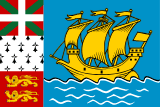
- description: a yellow three-masted sailing ship facing the left side rides on a blue background with wavy white lines; a black-over-white wavy line divides the ship from the white wavy lines; on the left side, a vertical band is divided into three heraldic arms: the top (called ikkurina) is red with a green diagonal cross extending to the corners and overlaid with a white cross, the middle is white with an ermine pattern, and the bottom is red with two yellow lions outlined in black
meaning: the arms represent settlers from the Basque Country (top), Brittany, and Normandy in France; blue symbolizes the Atlantic Ocean, and the ship represents explorer Jacques Cartier's ship when he visited the islands in 1536
Capital
- Name
- Saint-Pierre
- Etymology
- may be named after Saint Peter, the patron saint of fisherman; alternatively, the name may come from one of the two navigators for whom the island as a whole is named
- Time difference
- UTC-3 (2 hours ahead of Washington, DC, during Standard Time)
- Daylight saving time
- +1hr, begins second Sunday in March; ends first Sunday in November
- Geographic coordinates
- 46 46 N, 56 11 W
- Suffrage
- 18 years of age; universal
- Citizenship
- see France
Constitution
- History
- 4 October 1958 (French Constitution)
- Amendment process
- amendment procedures of France's constitution apply
Country Name
- Etymology
- Saint-Pierre and Miquelon is reputed to be named after two navigators, one called Peter and one called Michael (in a nickname form) or Mikelon, a Basque name
- Local long form
- Département de Saint-Pierre et Miquelon
- Local short form
- Saint-Pierre et Miquelon
- Conventional long form
- Territorial Collectivity of Saint Pierre and Miquelon
- Conventional short form
- Saint Pierre and Miquelon
- Independence
- none (overseas collectivity collectivity of France; has been under French control since 1763)
- Legal system
- French civil law
- Government type
- parliamentary democracy (Territorial Council); overseas collectivity of France
Judicial Branch
- Highest court(s)
- Superior Tribunal of Appeals or Tribunal Supérieur d'Appel (composition NA)
- Judge selection and term of office
- judge selection and tenure NA
Executive Branch
- Cabinet
- Le Cabinet du Préfet
- Chief of state
- President Emmanuel MACRON (since 14 May 2017); represented by Prefect Bruno ANDRE (since September 2023)
- Election results
2020: Bernard BRIAND elected President of Territorial Council; Territorial Council vote - 17 for, 2 abstentions
2017: Stephane LENORMAND elected President of Territorial Council vote - NA- Head of government
- President of Territorial Council Marc DIDIO (since 12 January 2026)
- Most recent election date
- 13 October 2020
- Election/appointment process
- French president directly elected by absolute-majority popular vote in 2 rounds, if needed, for a 5-year term (eligible for a second term); prefect appointed by French president on the advice of French Ministry of Interior; Territorial Council president elected by Territorial Council councilors by absolute majority vote; term NA
- National holiday
- Fête de la Fédération, 14 July (1790)
- Dependency status
- overseas collectivity of France
- Political parties
- Archipelago Tomorrow (Archipel Domain) or AD (affiliated with The Republicans)
Focus on the Future (Cap sur l'Avenir) (affiliated with Left Radical Party)
Together to Build (Ensemble pour Construire)
Legislative Branch
- Note
- note: 1 senator is indirectly elected to the French Senate by an electoral college for a 6-year term, and 1 deputy is directly elected to the French National Assembly for a 5-year term
- Term in office
- 6 years
- Number of seats
- 19 (directly elected)
- Electoral system
- plurality/majority
- Legislature name
- Territorial Council (Conseil Territorial)
- Scope of elections
- full renewal
- Legislative structure
- unicameral
- Most recent election date
- 3/27/2022
- Expected date of next election
- March 2028
- Parties elected and seats per party
- AD (15); Focus on the Future (4)
National Anthem(s)
- Title
- "La Marseillaise" (The Song of Marseille)
- History
- official anthem, as a French collectivity
- Lyrics/music
- Claude-Joseph ROUGET de Lisle
- National symbol(s)
- 16th-century sailing ship
- Administrative divisions
- no first-order administrative divisions as defined by the US government, but 2 communes are considered second-order: Saint Pierre, Miquelon
- Diplomatic representation in the US
- none (overseas territory of France)
Diplomatic Representation from the US
- Embassy
- none (territorial overseas collectivity of France)
- International organisations
- UPU, WFTU (NGOs)
Economy
- Industries
- fish processing and supply base for fishing fleets; tourism
Exchange Rates
- Currency
- euros (EUR) per US dollar -
- Exchange rates 2020
- 0.876 (2020 est.)
- Exchange rates 2021
- 0.845 (2021 est.)
- Exchange rates 2022
- 0.95 (2022 est.)
- Exchange rates 2023
- 0.925 (2023 est.)
- Exchange rates 2024
- 0.924 (2024 est.)
- Economic overview
- high-income, French North American territorial economy; primarily fishing exports; substantial French Government support; highly seasonal labor force; euro user; increasing tourism and aquaculture investments
- Exports partners
- Canada 78%, Ireland 5%, France 5%, Djibouti 4%, UK 2% (2023)
- Imports partners
- France 57%, Canada 37%, Netherlands 3%, Belgium 2%, Spain 0% (2023)
- Agricultural products
- vegetables; poultry, cattle, sheep, pigs; fish
- Exports commodities
- processed crustaceans, shellfish (2023)
- Imports commodities
- refined petroleum, packaged medicine, cars, plastic products, other foods (2023)
- GDP (official exchange rate)
- $261.3 million (2015 est.)
Real GDP (Purchasing Power Parity)
- Civica canonical (reconciled)
- $261.3 million (2015 est.)
- Note
- note: supplemented by annual payments from France of about $60 million
- Real GDP (purchasing power parity) 2015
- $261.3 million (2015 est.)
Energy
Petroleum
- Refined petroleum consumption
- 400 bbl/day (2023 est.)
Electricity
- Consumption
- 48.714 million kWh (2023 est.)
- Installed generating capacity
- 26,000 kW (2023 est.)
- Transmission/distribution losses
- 2 million kWh (2023 est.)
Electricity Generation Sources
- Fossil fuels
- 100% of total installed capacity (2023 est.)
Communications
Internet Users
- Percent of population
- 88.7% (2022 est.)
- Broadcast media
- 8 TV stations, all part of the French Overseas Network, and local cable provided by SPM Telecom; 3 of 4 radio stations are part of the French Overseas Network (2021)
- Internet country code
- .pm
Telephones Fixed Lines
- Total subscriptions
- 4,800 (2015 est.)
- Subscriptions per 100 inhabitants
- 76 (2015 est.)
Transport
Ports
- Large
- 0
- Small
- 1
- Medium
- 0
- Key ports
- Miquelon, St. Pierre
- Very small
- 0
- Total ports
- 2 (2024)
- Size unknown
- 1
- Ports with oil terminals
- 1
- Airports
- 2 (2025)
Environment
- Climate
- cold and wet, with considerable mist and fog; spring and autumn are often windy
Land Use
- Other
- 86.3% (2023 est.)
- Forest
- 5% (2023 est.)
- Agricultural land
- 8.7% (2023 est.)
- Agricultural land: arable land
- arable land: 8.7% (2023 est.)
- Agricultural land: permanent crops
- permanent crops: 0% (2022 est.)
- Agricultural land: permanent pasture
- permanent pasture: 0% (2022 est.)
Urbanization
- Urban population
- 90.1% of total population (2023)
- Rate of urbanization
- 0.75% annual rate of change (2020-25 est.)
- Environmental issues
- overfishing
Carbon Dioxide Emissions
- Total emissions
- 57,000 metric tonnes of CO2 (2023 est.)
- From petroleum and other liquids
- 57,000 metric tonnes of CO2 (2023 est.)
Military & Security
- Military note
- defense is the responsibility of France
Cite this page
Cite this page
Civica. (2026). Civica Atlas — Saint Pierre and Miquelon — vintage 2026-Q1: Saint Pierre and Miquelon factbook. Civica Atlas. Retrieved May 7, 2026, from https://civicaatlas.org/factbook/saint-pierre-and-miquelon
Sources: CIA World Factbook