Uganda
 Uganda
⌘K
Overview
- Background
- An ancient crossroads for various migrations, Uganda has as many as 65 ethnic groups that speak languages from three of Africa’s four major linguistic families. As early as 1200, fertile soils and regular rainfall in the south fostered the formation of several large, centralized kingdoms, including Buganda, from which the country derives its name. Muslim traders from Egypt reached northern Uganda in the 1820s, and Swahili merchants from the Indian Ocean coast arrived in the south by the 1840s. The area attracted the attention of British explorers seeking the source of the Nile River in the 1860s, and this influence expanded in subsequent decades with the arrival of Christian missionaries and trade agreements; Uganda was declared a British protectorate in 1894. Buganda and other southern kingdoms negotiated agreements with Britain to secure privileges and a level of autonomy that were rare during the colonial period in Africa. Uganda's colonial boundaries grouped together a wide range of ethnic groups with different political systems and cultures, and the disparities between how Britain governed southern and northern areas compounded these differences, complicating efforts to establish a cohesive independent country.
Uganda gained independence in 1962 with one of the more developed economies and one of the strongest education systems in Sub-Saharan Africa, but it descended within a few years into political turmoil and internal conflict that lasted more than two decades. In 1966, Prime Minister Milton OBOTE suspended the constitution and violently deposed President Edward MUTESA, who was also the king of Buganda. Idi AMIN seized power in 1971 through a military coup and led the country into economic ruin and rampant mass atrocities that killed as many as 500,000 civilians. AMIN’s annexation of Tanzanian territory in 1979 provoked Tanzania to invade Uganda, depose AMIN, and install a coalition government. In the aftermath, Uganda continued to experience atrocities, looting, and political instability and had four different heads of state between 1979 and 1980. OBOTE regained the presidency in 1980 through a controversial election that sparked renewed guerrilla warfare, killing as an estimated 300,000 civilians. Gen. Tito OKELLO seized power in a coup in 1985, but his rule was short-lived, with Yoweri MUSEVENI becoming president in 1986 after his insurgency captured the capital. MUSEVENI is widely credited with restoring relative stability and economic growth to Uganda but has resisted calls to leave office. In 2017, parliament removed presidential age limits, making it possible for MUSEVENI to remain in office for life.
Geography
Area
- Land
- 197,100 sq km
- Water
- 43,938 sq km
- Total
- 241,038 sq km
- Climate
- tropical; generally rainy with two dry seasons (December to February, June to August); semiarid in northeast
- Terrain
- mostly plateau with rim of mountains
Land Use
- Other
- 16% (2023 est.)
- Forest
- 12.1% (2023 est.)
- Agricultural land
- 71.9% (2023 est.)
- Agricultural land: arable land
- arable land: 34.4% (2023 est.)
- Agricultural land: permanent crops
- permanent crops: 11% (2023 est.)
- Agricultural land: permanent pasture
- permanent pasture: 26.5% (2023 est.)
- Location
- East-Central Africa, west of Kenya, east of the Democratic Republic of the Congo
- Coastline
- 0 km (landlocked)
Elevation
- Lowest point
- Albert Nile 614 m
- Highest point
- Margherita Peak on Mount Stanley 5,110 m
- Irrigated land
- 105 sq km (2013)
- Map references
- Africa
Land Boundaries
- Total
- 2,729 km
- Border countries
- Democratic Republic of the Congo 877 km; Kenya 814 km; Rwanda 172 km; South Sudan 475 km; Tanzania 391 km
- Maritime claims
- none (landlocked)
- Natural hazards
- droughts; floods; earthquakes; landslides; hailstorms
- Geography note
- landlocked; fertile, well-watered country with many lakes and rivers; Lake Victoria, the world's largest tropical lake and second-largest freshwater lake, is shared among three countries: Kenya, Tanzania, and Uganda
- Natural resources
- copper, cobalt, hydropower, limestone, salt, arable land, gold
- Area comparative
- slightly more than two times the size of Pennsylvania; slightly smaller than Oregon
- Geographic coordinates
- 1 00 N, 32 00 E
- Population distribution
- population density is relatively high in comparison to other African nations; most of the population is concentrated in the central and southern parts of the country, particularly along the shores of Lake Victoria and Lake Albert; the northeast is least populated, as shown in this population distribution map
Major Lakes (Area Sq Km)
- Fresh water lake(s)
- Lake Victoria (shared with Tanzania and Kenya) - 62,940 sq km; Lake Albert (shared with Democratic Republic of Congo) - 5,590 sq km; Lake Kyoga - 4,430 sq km; Lake Edward (shared with Democratic Republic of Congo) - 2,150 sq km
Major Watersheds (Area Sq Km)
- Atlantic ocean drainage
- Congo (3,730,881 sq km), (Mediterranean Sea) Nile (3,254,853 sq km)
- Major rivers (BY length in km)
- Nile (shared with Rwanda [s], Tanzania, South Sudan, Sudan, and Egypt [m]) - 6,650 km
note: [s] after country name indicates river source; [m] after country name indicates river mouth
People & Society
Literacy
- Male
- 78.5% (2016 est.)
- Female
- 61% (2016 est.)
- Total population
- 69.1% (2016 est.)
- Languages
- English (official), Ganda or Luganda (most widely used of the Niger-Congo languages and the language used most often in the capital), other Niger-Congo languages, Nilo-Saharan languages, Swahili (official), Arabic
- Religions
- Protestant 45.1% (Anglican 32.0%, Pentecostal/Born Again/Evangelical 11.1%, Seventh Day Adventist 1.7%, Baptist .3%), Roman Catholic 39.3%, Muslim 13.7%, other 1.6%, none 0.2% (2014 est.)
Sex Ratio
- At birth
- 1.03 male(s)/female
- 0 14 years
- 1.03 male(s)/female
- 15 64 years
- 0.9 male(s)/female
- Total population
- 0.95 male(s)/female (2024 est.)
- 65 years and over
- 0.74 male(s)/female
- Birth rate
- 38.91 births/1,000 population (2025 est.)
- Death rate
- 4.61 deaths/1,000 population (2025 est.)
Median Age
- Male
- 15.5 years
- Total
- 16.4 years (2025 est.)
- Female
- 17.1 years
Population
- Male
- 24,835,513
- Total
- 50,863,850 (2025 est.)
- Female
- 26,028,337
Nationality
- Noun
- Ugandan(s)
- Adjective
- Ugandan
Tobacco Use
- Male
- 7.8% (2025 est.)
- Total
- 4.5% (2025 est.)
- Female
- 1.5% (2025 est.)
Urbanization
- Urban population
- 26.8% of total population (2023)
- Rate of urbanization
- 5.41% annual rate of change (2020-25 est.)
Age Structure
- 0 14 years
- 47% (male 11,747,745/female 11,427,932)
- 15 64 years
- 50.6% (male 11,788,483/female 13,131,051)
- 65 years and over
- 2.4% (2024 est.) (male 504,332/female 683,498)
- Ethnic groups
- Baganda 16.5%, Banyankole 9.6%, Basoga 8.8%, Bakiga 7.1%, Iteso 7%, Langi 6.3%, Bagisu 4.9%, Acholi 4.4%, Lugbara 3.3%, other 32.1% (2014 est.)
Child Marriage
- Men married BY age 18
- 5.5% (2016)
- Women married BY age 15
- 7.3% (2016)
- Women married BY age 18
- 34% (2016)
Dependency Ratios
- Total dependency ratio
- 96.9 (2025 est.)
- Youth dependency ratio
- 92.1 (2025 est.)
- Potential support ratio
- 20.8 (2025 est.)
- Elderly dependency ratio
- 4.8 (2025 est.)
- Physician density
- 0.19 physicians/1,000 population (2022)
Health Expenditure
- Health expenditure (as % of GDP)
- 4.7% of GDP (2021)
- Health expenditure (as % of national budget)
- 4.9% of national budget (2022 est.)
- Net migration rate
- -2.96 migrant(s)/1,000 population (2025 est.)
- Total fertility rate
- 5.08 children born/woman (2025 est.)
Drinking Water Source
- Improved: rural
- rural: 51.8% of population (2022 est.)
- Improved: total
- total: 59.3% of population (2022 est.)
- Improved: urban
- urban: 80.3% of population (2022 est.)
- Unimproved: rural
- rural: 48.2% of population (2022 est.)
- Unimproved: total
- total: 40.7% of population (2022 est.)
- Unimproved: urban
- urban: 19.7% of population (2022 est.)
Education Expenditure
- Education expenditure (% GDP)
- 2.6% of GDP (2022 est.)
- Education expenditure (% national budget)
- 8.5% national budget (2022 est.)
Infant Mortality Rate
- Male
- 31.8 deaths/1,000 live births
- Total
- 27.5 deaths/1,000 live births (2025 est.)
- Female
- 25.1 deaths/1,000 live births
- Population growth rate
- 3.13% (2025 est.)
- Gross reproduction rate
- 2.5 (2025 est.)
- Population distribution
- population density is relatively high in comparison to other African nations; most of the population is concentrated in the central and southern parts of the country, particularly along the shores of Lake Victoria and Lake Albert; the northeast is least populated, as shown in this population distribution map
Life Expectancy at Birth
- Male
- 67.5 years
- Female
- 72 years
- Total population
- 69.7 years (2024 est.)
- Maternal mortality ratio
- 170 deaths/100,000 live births (2023 est.)
Sanitation Facility Access
- Improved: rural
- rural: 27.9% of population (2022 est.)
- Improved: total
- total: 38.2% of population (2022 est.)
- Improved: urban
- urban: 67.1% of population (2022 est.)
- Unimproved: rural
- rural: 72.1% of population (2022 est.)
- Unimproved: total
- total: 61.8% of population (2022 est.)
- Unimproved: urban
- urban: 32.9% of population (2022 est.)
Alcohol Consumption Per Capita
- Beer
- 0.85 liters of pure alcohol (2019 est.)
- Wine
- 0.01 liters of pure alcohol (2019 est.)
- Total
- 6.82 liters of pure alcohol (2019 est.)
- Spirits
- 0.5 liters of pure alcohol (2019 est.)
- Other alcohols
- 5.46 liters of pure alcohol (2019 est.)
- Major urban areas population
- 3.846 million KAMPALA (capital) (2023)
- Obesity adult prevalence rate
- 5.3% (2016)
- Mother's mean age at first birth
- 19.4 years (2016 est.)
- Currently married women (ages 15 49)
- 57.8% (2022 est.)
- Children under the age of 5 years underweight
- 9.7% (2022 est.)
School Life Expectancy (Primary to Tertiary Education)
- Male
- 10 years (2016 est.)
- Total
- 9 years (2016 est.)
- Female
- 9 years (2016 est.)
Government
Civica · structure
How power is organised
ExecutiveLegislative
- Flag
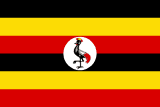
- description: six equal horizontal bands of black (top), yellow, red, black, yellow, and red; a white disk is at the center and shows a grey crowned crane (the national symbol)
meaning: black stands for the African people, yellow for sunshine and vitality, and red for African brotherhood
Capital
- Name
- Kampala
- Etymology
- the name is said to come from an African antelope, the impala
- Time difference
- UTC+3 (8 hours ahead of Washington, DC, during Standard Time)
- Geographic coordinates
- 0 19 N, 32 33 E
- Suffrage
- 18 years of age; universal
Citizenship
- Citizenship BY birth
- no
- Citizenship BY descent only
- at least one parent or grandparent must be a native-born citizen of Uganda
- Dual citizenship recognized
- yes
- Residency requirement for naturalization
- an aggregate of 20 years and continuously for the last 2 years prior to applying for citizenship
Constitution
- History
- several previous; latest adopted 27 September 1995, promulgated 8 October 1995
- Amendment process
- proposed by the National Assembly; passage requires at least two-thirds majority vote of the Assembly membership in the second and third readings; proposals affecting "entrenched clauses," including the sovereignty of the people, supremacy of the constitution, human rights and freedoms, the democratic and multiparty form of government, presidential term of office, independence of the judiciary, and the institutions of traditional or cultural leaders, also requires passage by referendum, ratification by at least two-thirds majority vote of district council members in at least two thirds of Uganda's districts, and assent of the president of the republic
Country Name
- Etymology
- the name is derived from the Swahili word u, meaning "land" or "country," and the Ganda people; the origin of the Ganda name is unclear
- Conventional long form
- Republic of Uganda
- Conventional short form
- Uganda
- Independence
- 9 October 1962 (from the UK)
- Legal system
- mixed system of English common law and customary law
- Government type
- presidential republic
Judicial Branch
- Highest court(s)
- Supreme Court of Uganda (consists of the chief justice and at least 6 justices)
- Subordinate courts
- Court of Appeal (also acts as the Constitutional Court); High Court (includes 12 High Court Circuits and 8 High Court Divisions); Industrial Court; Chief Magistrate Grade One and Grade Two Courts throughout the country; qadhis courts; local council courts; family and children courts
- Judge selection and term of office
- justices appointed by the president of the republic in consultation with the Judicial Service Commission, an 8-member independent advisory body, and approved by the National Assembly; justices serve until mandatory retirement at age 70
Executive Branch
- Cabinet
- Cabinet appointed by the president from among elected members of Parliament or persons who qualify to be elected as members of Parliament
- Chief of state
- President Yoweri Kaguta MUSEVENI (since 26 January 1986)
- Election results
2021: Yoweri Kaguta MUSEVENI reelected president in the first round; percent of vote - Yoweri Kaguta MUSEVENI (NRM) 58.6%, Robert Kyagulanyi SSENTAMU (aka Bobi WINE) (NUP) 34.8%, Patrick Oboi AMURIAT (FDC) 3.2%, other 3.4%- Head of government
- Prime Minister Robinah NABBANJA (since 14 June 2021)
- Most recent election date
- 14 January 2021
- Election/appointment process
- president directly elected by absolute-majority popular vote in 2 rounds, if needed, for a 5-year term (no term limits)
- Expected date of next election
- 2026
- National holiday
- Independence Day, 9 October (1962)
- National color(s)
- black, yellow, red
National Heritage
- Total world heritage sites
- 3 (1 cultural, 2 natural)
- Selected world heritage site locales
- Bwindi Impenetrable National Park (n); Rwenzori Mountains National Park (n); Tombs of Buganda Kings at Kasubi (c)
- Political parties
- Democratic Party or DP
Forum for Democratic Change or FDC
Justice Forum or JEEMA
National Resistance Movement or NRM
National Unity Platform
People's Progressive Party or PPP
Uganda People's Congress or UPC
Legislative Branch
- Term in office
- 5 years
- Number of seats
- 529 (499 directly elected; 30 indirectly elected)
- Electoral system
- plurality/majority
- Legislature name
- Parliament
- Scope of elections
- full renewal
- Legislative structure
- unicameral
- Most recent election date
- 1/14/2021 to 1/18/2021
- Expected date of next election
- January 2026
- Percentage of women in chamber
- 34.1%
- Parties elected and seats per party
- National Resistance Movement (NRM) (336); National Unity Platform (NUP) (57); Forum for Democratic Change (FDC) (32); Independents (74); Other (30)
National Anthem(s)
- Title
- "O Uganda, Land of Beauty!"
- History
- adopted 1962; one of the shortest national anthems in the world
- Lyrics/music
- George Wilberforce KAKOMOA
- National symbol(s)
- grey crowned crane
- Administrative divisions
- 134 districts and 1 capital city*; Abim, Adjumani, Agago, Alebtong, Amolatar, Amudat, Amuria, Amuru, Apac, Arua, Budaka, Bududa, Bugiri, Bugweri, Buhweju, Buikwe, Bukedea, Bukomansimbi, Bukwo, Bulambuli, Buliisa, Bundibugyo, Bunyangabu, Bushenyi, Busia, Butaleja, Butambala, Butebo, Buvuma, Buyende, Dokolo, Gomba, Gulu, Hoima, Ibanda, Iganga, Isingiro, Jinja, Kaabong, Kabale, Kabarole, Kaberamaido, Kagadi, Kakumiro, Kalaki, Kalangala, Kaliro, Kalungu, Kampala*, Kamuli, Kamwenge, Kanungu, Kapchorwa, Kapelebyong, Karenga, Kasese, Kasanda, Katakwi, Kayunga, Kazo, Kibaale, Kiboga, Kibuku, Kikuube, Kiruhura, Kiryandongo, Kisoro, Kitagwenda, Kitgum, Koboko, Kole, Kotido, Kumi, Kwania, Kween, Kyankwanzi, Kyegegwa, Kyenjojo, Kyotera, Lamwo, Lira, Luuka, Luwero, Lwengo, Lyantonde, Madi-Okollo, Manafwa, Maracha, Masaka, Masindi, Mayuge, Mbale, Mbarara, Mitooma, Mityana, Moroto, Moyo, Mpigi, Mubende, Mukono, Nabilatuk, Nakapiripirit, Nakaseke, Nakasongola, Namayingo, Namisindwa, Namutumba, Napak, Nebbi, Ngora, Ntoroko, Ntungamo, Nwoya, Obongi, Omoro, Otuke, Oyam, Pader, Pakwach, Pallisa, Rakai, Rubanda, Rubirizi, Rukiga, Rukungiri, Rwampara, Sembabule, Serere, Sheema, Sironko, Soroti, Tororo, Wakiso, Yumbe, Zombo
Diplomatic Representation in the US
- Fax
- [1] (202) 726-1727
- Chancery
- 5911 16th Street NW, Washington, DC 20011
- Telephone
- [1] (202) 726-7100
- Chief of mission
- Ambassador Robie KAKONGE (since 12 December 2022)
- Email address and website
washington@mofa.go.ug
https://washington.mofa.go.ug/
Diplomatic Representation from the US
- Fax
- [256] (0) 414-259-794
- Embassy
- 1577 Ggaba Road, Kampala
- Telephone
- [256] (0) 312-306-001
- Mailing address
- 2190 Kampala Place, Washington DC 20521-2190
- Chief of mission
- Ambassador William W. POPP (since 20 September 2023)
- Email address and website
KampalaWebContact@state.gov
https://ug.usembassy.gov/
- International organisations
- ACP, AfDB, ATMIS, AU, C, COMESA, EAC, EADB, FAO, G-77, IAEA, IBRD, ICAO, ICC (national committees), ICCt, IDA, IDB, IFAD, IFC, IFRCS, IGAD, ILO, IMF, IMO, Interpol, IOC, IOM, IPU, ISO (correspondent), ITC, ITSO, ITU, ITUC (NGOs), MIGA, NAM, OIC, OPCW, PCA, UN, UNCDF, UNCTAD, UNECA, UNDP, UNFPA, UNESCO, UNHCR, UNICEF, UNIDO, UNISFA, UNOCI, UNOPS, UNSOM, UNWTO, UPU, WCO, WFP, WFTU (NGOs), WHO, WIPO, WMO, WTO
- International law organization participation
- accepts compulsory ICJ jurisdiction; accepts ICCt jurisdiction
Legislature
UGANDA · LEGISLATURE
Parliament
529 seats · hover a seat for the party
Total seats
529
Majority line
266
Largest party
National Resistance Movement
Parties
10
All political parties
Leaders
Current
Yoweri Museveni
- Head of State
Robinah Nabbanja
- Head of Government
Economy
Budget
- Note
- note: central government revenues (excluding grants) and expenditures converted to US dollars at average official exchange rate for year indicated
- Revenues
- $7.616 billion (2023 est.)
- Expenditures
- $10.043 billion (2023 est.)
Exports
- Civica canonical (reconciled)
- $9.0B
- Note
- note: balance of payments - exports of goods and services in current dollars
- Exports 2021
- $6.231 billion (2021 est.)
- Exports 2022
- $6.116 billion (2022 est.)
- Exports 2023
- $9.084 billion (2023 est.)
Imports
- Civica canonical (reconciled)
- $14.0B
- Note
- note: balance of payments - imports of goods and services in current dollars
- Imports 2021
- $10.62 billion (2021 est.)
- Imports 2022
- $11.079 billion (2022 est.)
- Imports 2023
- $13.853 billion (2023 est.)
- Industries
- sugar processing, brewing, tobacco, cotton textiles; cement, steel production
- Labor force
- 22.829 million (2024 est.)
Public Debt
- Civica canonical (reconciled)
- 54.4%
- Note
- note: central government debt as a % of GDP
- Public debt 2023
- 53.1% of GDP (2023 est.)
Remittances
- Note
- note: personal transfers and compensation between resident and non-resident individuals/households/entities
- Remittances 2021
- 2.9% of GDP (2021 est.)
- Remittances 2022
- 2.7% of GDP (2022 est.)
- Remittances 2023
- 2.9% of GDP (2023 est.)
Exchange Rates
- Currency
- Ugandan shillings (UGX) per US dollar -
- Exchange rates 2020
- 3,718.249 (2020 est.)
- Exchange rates 2021
- 3,587.052 (2021 est.)
- Exchange rates 2022
- 3,689.817 (2022 est.)
- Exchange rates 2023
- 3,726.14 (2023 est.)
- Exchange rates 2024
- 3,757.263 (2024 est.)
Debt External
- Note
- note: present value of external debt in current US dollars
- Debt external 2023
- $10.469 billion (2023 est.)
- Economic overview
- low-income, primarily agrarian East African economy; COVID-19 hurt economic growth and poverty reduction; lower oil prices threaten prior sector investments; endemic corruption; natural resource rich; high female labor force participation but undervalued
Unemployment Rate
- Civica canonical (reconciled)
- 2.7%
- Note
- note: % of labor force seeking employment
- Unemployment rate 2022
- 2.9% (2022 est.)
- Unemployment rate 2023
- 2.8% (2023 est.)
- Unemployment rate 2024
- 3% (2024 est.)
- Exports partners
- India 21%, UAE 16%, Hong Kong 10%, South Sudan 8%, Kenya 6% (2023)
- Imports partners
- China 19%, UAE 12%, Tanzania 11%, India 10%, Kenya 7% (2023)
Real GDP Per Capita
- Civica canonical (reconciled)
- $3,273
- Note
- note: data in 2021 dollars
- Real GDP per capita 2022
- $2,700 (2022 est.)
- Real GDP per capita 2023
- $2,800 (2023 est.)
- Real GDP per capita 2024
- $2,900 (2024 est.)
Real GDP Growth Rate
- Civica canonical (reconciled)
- 6.1%
- Note
- note: annual GDP % growth based on constant local currency
- Real GDP growth rate 2022
- 4.6% (2022 est.)
- Real GDP growth rate 2023
- 5.3% (2023 est.)
- Real GDP growth rate 2024
- 6.1% (2024 est.)
- Agricultural products
- plantains, sugarcane, milk, maize, cassava, sweet potatoes, vegetables, beans, potatoes, tea (2023)
- Exports commodities
- gold, coffee, fish, refined petroleum, tobacco (2023)
- Imports commodities
- refined petroleum, gold, plastics, packaged medicine, palm oil (2023)
Current Account Balance
- Civica canonical (reconciled)
- -$4.2B
- Note
- note: balance of payments - net trade and primary/secondary income in current dollars
- Current account balance 2021
- -$3.605 billion (2021 est.)
- Current account balance 2022
- -$4.064 billion (2022 est.)
- Current account balance 2023
- -$3.766 billion (2023 est.)
- Taxes and other revenues
- 13% (of GDP) (2023 est.)
- GDP (official exchange rate)
- $53.652 billion (2024 est.)
GDP Composition, BY End Use
- Note
- note: figures may not total 100% due to rounding or gaps in data collection
- Household consumption
- 66.3% (2024 est.)
- Government consumption
- 10% (2024 est.)
- Investment in inventories
- 0.8% (2024 est.)
- Investment in fixed capital
- 21.5% (2024 est.)
- Exports of goods and services
- 16.9% (2024 est.)
- Imports of goods and services
- -24.6% (2024 est.)
- Population below poverty line
- 20.3% (2019 est.)
Average Household Expenditures
- On food
- 38.6% of household expenditures (2023 est.)
- On alcohol and tobacco
- 1.5% of household expenditures (2023 est.)
Inflation Rate (Consumer Prices)
- Civica canonical (reconciled)
- 3.3%
- Note
- note: annual % change based on consumer prices
- Inflation rate (consumer prices) 2022
- 7.2% (2022 est.)
- Inflation rate (consumer prices) 2023
- 5.4% (2023 est.)
- Inflation rate (consumer prices) 2024
- 3.3% (2024 est.)
- Industrial production growth rate
- 4.9% (2024 est.)
Real GDP (Purchasing Power Parity)
- Civica canonical (reconciled)
- $144.137 billion (2024 est.)
- Note
- note: data in 2021 dollars
- Real GDP (purchasing power parity) 2022
- $128.923 billion (2022 est.)
- Real GDP (purchasing power parity) 2023
- $135.803 billion (2023 est.)
- Real GDP (purchasing power parity) 2024
- $144.137 billion (2024 est.)
Youth Unemployment Rate (Ages 15 24)
- Male
- 3.5% (2024 est.)
- Note
- note: % of labor force ages 15-24 seeking employment
- Total
- 4.5% (2024 est.)
- Female
- 5.5% (2024 est.)
Reserves of Foreign Exchange and Gold
- Note
- note: holdings of gold (year-end prices)/foreign exchange/special drawing rights in current dollars
- Reserves of foreign exchange and gold 2016
- $3.098 billion (2016 est.)
- Reserves of foreign exchange and gold 2017
- $3.721 billion (2017 est.)
- Reserves of foreign exchange and gold 2018
- $3.359 billion (2018 est.)
GDP Composition, BY Sector of Origin
- Note
- note: figures may not total 100% due to non-allocated consumption not captured in sector-reported data
- Industry
- 24.9% (2024 est.)
- Services
- 43.1% (2024 est.)
- Agriculture
- 24.7% (2024 est.)
Household Income or Consumption BY Percentage Share
- Note
- note: % share of income accruing to lowest and highest 10% of population
- Lowest 10%
- 2.4% (2019 est.)
- Highest 10%
- 34.5% (2019 est.)
Gini Index Coefficient Distribution of Family Income
- Note
- note: index (0-100) of income distribution; higher values represent greater inequality
- Gini index coefficient distribution of family income 2019
- 42.7 (2019 est.)
Energy
Coal
- Exports
- 100 metric tons (2023 est.)
- Imports
- 19 metric tons (2023 est.)
- Consumption
- 19 metric tons (2023 est.)
- Proven reserves
- 799.999 million metric tons (2023 est.)
Petroleum
- Crude oil estimated reserves
- 2.5 billion barrels (2021 est.)
- Refined petroleum consumption
- 44,000 bbl/day (2023 est.)
Electricity
- Exports
- 400.349 million kWh (2023 est.)
- Imports
- 23.289 million kWh (2023 est.)
- Consumption
- 4.254 billion kWh (2023 est.)
- Installed generating capacity
- 1.452 million kW (2023 est.)
- Transmission/distribution losses
- 1.116 billion kWh (2023 est.)
Natural Gas
- Proven reserves
- 14.158 billion cubic meters (2021 est.)
Electricity Access
- Electrification rural areas
- 35.9%
- Electrification urban areas
- 72%
- Electrification total population
- 47.1% (2022 est.)
Energy Consumption Per Capita
- Total energy consumption per capita 2023
- 2.252 million Btu/person (2023 est.)
Electricity Generation Sources
- Solar
- 2.6% of total installed capacity (2023 est.)
- Fossil fuels
- 2.6% of total installed capacity (2023 est.)
- Hydroelectricity
- 86.6% of total installed capacity (2023 est.)
- Biomass and waste
- 8.2% of total installed capacity (2023 est.)
Communications
Internet Users
- Percent of population
- 15% (2023 est.)
- Broadcast media
- public broadcaster, Uganda Broadcasting Corporation (UBC), operates radio and TV networks; 31 Free-To-Air (FTA) TV stations, 2 digital terrestrial TV stations, 3 cable TV stations, and 5 digital satellite TV stations; 258 FM stations
- Internet country code
- .ug
Telephones Fixed Lines
- Total subscriptions
- 116,000 (2023 est.)
- Subscriptions per 100 inhabitants
- (2023 est.) less than 1
Telephones Mobile Cellular
- Total subscriptions
- 41.6 million (2024 est.)
- Subscriptions per 100 inhabitants
- 83 (2024 est.)
Broadband Fixed Subscriptions
- Total
- 44,000 (2023 est.)
- Subscriptions per 100 inhabitants
- (2023 est.) less than 1
Transport
- Airports
- 39 (2025)
Railways
- Total
- 1,244 km (2014)
- Narrow gauge
- 1,244 km (2014) 1.000-m gauge
- Civil aircraft registration country code prefix
- 5X
Environment
- Climate
- tropical; generally rainy with two dry seasons (December to February, June to August); semiarid in northeast
Land Use
- Other
- 16% (2023 est.)
- Forest
- 12.1% (2023 est.)
- Agricultural land
- 71.9% (2023 est.)
- Agricultural land: arable land
- arable land: 34.4% (2023 est.)
- Agricultural land: permanent crops
- permanent crops: 11% (2023 est.)
- Agricultural land: permanent pasture
- permanent pasture: 26.5% (2023 est.)
Urbanization
- Urban population
- 26.8% of total population (2023)
- Rate of urbanization
- 5.41% annual rate of change (2020-25 est.)
Waste and Recycling
- Municipal solid waste generated annually
- 7.045 million tons (2024 est.)
- Percent of municipal solid waste recycled
- 24.1% (2022 est.)
- Environmental issues
- draining of wetlands for agricultural use; deforestation; overgrazing; soil erosion; water pollution from industrial discharge and water hyacinth infestation in Lake Victoria; widespread poaching
Total Water Withdrawal
- Municipal
- 328 million cubic meters (2022 est.)
- Industrial
- 50 million cubic meters (2022 est.)
- Agricultural
- 259 million cubic meters (2022 est.)
Carbon Dioxide Emissions
- Total emissions
- 6.354 million metric tonnes of CO2 (2023 est.)
- From coal and metallurgical coke
- -398 metric tonnes of CO2 (2023 est.)
- From petroleum and other liquids
- 6.354 million metric tonnes of CO2 (2023 est.)
- Particulate matter emissions
- 31.3 micrograms per cubic meter (2019 est.)
- Total renewable water resources
- 60.1 billion cubic meters (2022 est.)
International Environmental Agreements
- Party to
- Biodiversity, Climate Change, Climate Change-Kyoto Protocol, Climate Change-Paris Agreement, Comprehensive Nuclear Test Ban, Desertification, Endangered Species, Hazardous Wastes, Law of the Sea, Marine Life Conservation, Nuclear Test Ban, Ozone Layer Protection, Ship Pollution, Wetlands
- Signed, but not ratified
- Environmental Modification
Military & Security
- Military note
- the responsibilities of the Uganda People's Defense Force (UPDF) include defending the sovereignty and territorial integrity of Uganda, assisting the civilian authorities in emergencies and natural disasters, contributing to regional security, participating in socio-economic development projects, conducting military diplomacy, and ensuring internal security, including against civil unrest, internal insurgency, and terrorism; in recent years it has beefed up its presence along the borders with the Democratic Republic of the Congo and South Sudan; the UPDF participates in African and UN peacekeeping missions and is a key contributor to the East Africa Standby Force; the UPDF is constitutionally granted seats in parliament and is widely viewed as a key constituency for MUSEVENI; it has been used to break up rallies, raid opposition offices, and surveil rival candidates
the military traces its history back to the formation of the Uganda Rifles in 1895 under the British colonial government; the Uganda Rifles were merged with the Central Africa Regiment and the East Africa Rifles to form the King’s African Rifles (KAR) in 1902, which participated in both world wars, as well as the Mau Mau rebellion in Kenya (1952-1960); in 1962, the Ugandan battalion of the KAR was transformed into the country's first military force, the Uganda Rifles, which was subsequently renamed the Uganda Army; the UPDF was established in 1995 from the former rebel National Resistance Army following the enactment of the 1995 Constitution of Uganda (2025) - Military deployments
- estimated 3,000 Democratic Republic of Congo; up to 4,500 Somalia (African Union Support and Stabilization Mission in Somalia or AUSSOM) (2025)
Military Expenditures
- Civica canonical (reconciled)
- 1.9%
- Military expenditures 2019
- 1.7% of GDP (2019 est.)
- Military expenditures 2020
- 2.5% of GDP (2020 est.)
- Military expenditures 2021
- 2.5% of GDP (2021 est.)
- Military expenditures 2022
- 2.2% of GDP (2022 est.)
- Military expenditures 2023
- 2% of GDP (2023 est.)
- Military and security forces
- Uganda People's Defense Force (UPDF): Land Force (includes marines), Air Force, Special Forces Command, Reserve Force
Ministry of Internal Affairs: Uganda Police Force (2025) - Military service age and obligation
- 18-22 years of age for voluntary military duty for men and women; 9-year service obligation (2025)
- Military equipment inventories and acquisitions
- most of the UPDF's arms are of Russian/Soviet origin with smaller quantities from such suppliers as Bulgaria, China, Czechia, Israel, and South Africa, as well as some domestically produced items; Uganda has a small defense industry that assembles or manufactures light armored vehicles and performs maintenance on some military equipment, including its Russian-made helicopters (2025)
- Military and security service personnel strengths
- approximately 45,000 active Defense Forces (2025)
Terrorism
- Terrorist group(s)
- al-Shabaab; Islamic State of Iraq and ash-Sham - Democratic Republic of Congo (ISIS-DRC)
Transnational Issues
Refugees and Internally Displaced Persons
- Idps
- 22,209 (2024 est.)
- Refugees
- 1,796,597 (2024 est.)
- Stateless persons
- 10,284 (2024 est.)
Scores & Rankings
ScoreValueGlobal rankTrendAs of
Civica Index27.0 / 100as of 2024-Q4141 / 1902024-Q4
Civica Pulse−2.2as of 2026-05-06—2026-05-06
V-Dem Liberal Democracy0.20as of 2024-Q4111 / 1702024-Q4
Freedom House StatusNot Free (25/100)as of 2024-Q4—2024-Q4
Press Freedom (RSF)Partly free (50/100)as of 2024—2024
Cite this page
Cite this page
Civica. (2026). Civica Atlas — Uganda — vintage 2026-Q1: Uganda factbook. Civica Atlas. Retrieved May 7, 2026, from https://civicaatlas.org/factbook/uganda
Sources: FAO FAOSTAT, ILO ILOSTAT, IMF (WEO), UN Statistics Division, UNDP HDR, UNESCO Institute for Statistics, V-Dem, WHO Global Health Observatory, World Bank, WTO Stats, CIA World Factbook, Wikidata